We were tied 24-24 in the fifth set of the State Championship Tournament. Our setter had been telegraphing the quick ball to the middle all night, so I knew what was coming before she even touched it — a Bic in the middle, low and fast, designed to catch their block flat-footed. I started my approach a half-step early, planted hard, and hit the sharp cross-court angle into the open seam. The ball hit the floor before their libero could read it.
That’s a kill. Not because I swung hard. Because the defense had no answer.
I’ve been chasing that feeling on the court — and now helping players understand it — for over fifteen years. A kill is the “checkmate” of a rally. It’s the moment the defensive system finally breaks. Power is the ceiling, but efficiency is the floor.
In 2026, the dangerous attacker isn’t the one who swings hardest — it’s the one who knows how to break the defensive system when the set is out-of-system (OOS). Mastering the “why” behind the kill is your first step toward a .300 hitting efficiency. This guide covers all of it — from the FIVB definition to the 2025 LOVB pro benchmarks that separate competitive hitters from elite ones.

What Officially Counts as a Kill
Quick Answer: A kill in volleyball is any attack that directly results in a point because the opponent cannot return the ball. Every kill is an attack, but only successful attacks that score become kills.
Official statisticians track three distinct scenarios under this definition.
The first is direct floor contact — your attack hits the floor on the opponent’s side untouched. The second is an uncontrolled touch — a defender contacts the ball but cannot make a playable pass, and the ball dies. The third, and most misunderstood, is the tooled block, also called a “wipe” or “block-out” — you deliberately redirect the ball off the blocker’s hands and out of bounds. That third kill counts toward YOUR total. The blocker’s team gets an attack error.
A critical note: a serve that scores directly is an ace, not a kill. The distinction matters statistically. Kills measure your effectiveness as an in-rally attacker. Aces measure your serving weapon. They’re tracked separately for a reason.
If you’re new to how the six rotational positions distribute offensive load, kills are the primary stat that tracks who is actually scoring — and how reliably.
The Kill Nobody Talks About: Tooling the Block
Most beginner attackers think a kill means the ball has to hit the floor untouched. That’s wrong — and it’s costing them points.
In elite volleyball, close to 30% of kills involve block contact. In the 2024 Women’s VNL, central attackers recorded a block-out rate of 7.5% on their spike attempts — deliberately weaponizing the block rather than trying to overpower it. Outside hitters who can’t tool the block are leaving a massive shot in the bag.
There are two ways to execute this. The first is “High Hands” — aiming at the very top of the blockers’ fingertips so the ball deflects up and over the antenna line. This is the safer option because you’re hitting above the block, not into it; if your aim is slightly off, you’re unlikely to drive the ball back into the net.
The second is the “Wipe” — aiming for the outside pinky finger of the blocker on the right side, redirecting the ball laterally out of bounds off their hands. The Wipe is higher reward but less forgiving. Your approach angle from Zone 4 carries the ball toward the right sideline naturally, which makes the Wipe effective from the left side — but if the blocker pulls their hands back quickly, you risk the antenna or a net touch.
For players learning to tool the block, start with High Hands. The contact window is larger, the error rate is lower, and once you’re comfortable redirecting the block with the top of your swing, the Wipe becomes an easier read to add.
My coach at the National Collegiate Volleyball Championship used to say: “If the block is there, it’s your teammate.” It took me two years to stop fighting blockers and start using them.
Kill % vs. Efficiency Index: The Number That Actually Matters
This is where most players — and a lot of recreational coaches — get the statistics completely wrong.
Kill Percentage (K%) is calculated as Kills divided by Total Attack Attempts. A player with 10 kills on 20 attempts has a 50% K%. Sounds impressive. But if they also committed 8 errors on those 20 swings, their hitting efficiency tells a completely different story.
Hitting Efficiency (the number coaches actually look at): (Kills − Errors) ÷ Total Attempts
Using that same example: (10 − 8) ÷ 20 = .100. That hitter is barely worth setting. They score, but they give back almost as much as they take.
K% measures your ceiling — how dangerous you are when everything works. Efficiency measures your floor — how reliable you are when it doesn’t. Coaches build offenses around the floor, not the ceiling. A player who hits .280 consistently on tough out-of-system balls is far more valuable than a player who can hammer a perfect set for a .400 kill rate and then give three errors on the next difficult ball.
The hitting percentage calculator on this site runs those numbers automatically. Plug in your match stats and you’ll see immediately which stat category you need to improve.
2025 Pro Benchmarks (LOVB Season)
The inaugural LOVB 2025 season gave us the first major domestic professional benchmark data for women’s volleyball in the United States. For the official season statistics and standings, the LOVB site is the authoritative source.
At the middle blocker position, Chiaka Ogbogu of LOVB Austin hit .327 efficiency — that’s the standard for elite middles. She led the league in blocks (53) while ranking fourth in kills among middles, proving that positional efficiency, not raw kill volume, defines elite performance. For the 2025-2026 pro season, competitive teams are targeting an Efficiency Index of .250 or higher across their attacking roster to remain competitive.
Positional benchmarks to aim for:
- Outside hitters: .230–.300 (they face harder sets and out-of-system balls)
- Opposite hitters: .250–.350
- Middle blockers: .300–.400 (they get shorter, faster sets with better angles)
Outside hitters carry the toughest load. They take the most swings, face the most out-of-system situations, and still carry the team’s offensive burden when the system breaks down. A .250 efficiency for an outside hitter playing 80% of their team’s sets is genuinely excellent.
Three Ways to Earn a Kill (The Full Picture)
1. The Power Kill
The standard: you jump, swing with full arm speed, and drive the ball into the floor before the defense can react. Arm speed, contact point above the net, and wrist snap on contact are what make this work. The most common attack in the game, and the one every outside hitter builds their game around.
Where most players go wrong: swinging at full power on an imperfect set. During my sophomore college season, I watched my efficiency drop to .190 because I was trying to crush every ball regardless of set quality. Bad sets require adjusted attacks — not more power. If you want the full technical breakdown on arm swing, approach footwork, and contact mechanics, the how to spike guide covers all of it.
2. The Off-Speed Kill
Tips, roll shots, and cut shots. These are kills too. The moment a defender can’t control their touch on your tip and it dies on the floor, you’ve earned the same point as a 70 mph line drive. The psychological difference is significant: off-speed kills show a blocker you’re reading them, not just swinging through them.
During the Great Lakes Regional Championship, I started getting read by their best blocker in set four. I went to the roll shot on the next three swings. Two of them died in the seam between the libero and the right-back defender. He never adjusted.
3. The Setter Dump Kill
A kill doesn’t have to come from an outside hitter or opposite. When a setter takes a perfect first pass and tips the ball into Zone 4 or Zone 1 on the second contact — catching the defense expecting a set — that’s a kill. It’s recorded the same way. It counts toward their statistics. And in a well-timed situation, it’s one of the most demoralizing points an offense can score.
This matters for topical authority in understanding the game: kills are about outcomes, not position. Anybody on the court, in any rotation, can earn one.
Kill Statistics Explained for Players and Coaches
Kills Per Set
This is the volume metric. It tells you how many times per set an attacker contributed a direct point. At the collegiate level, All-American outside hitters average 4.5–5.5 kills per set. High school elite players typically fall in the 3–5 range.
Middle blockers will always post lower kill-per-set totals than outside hitters — not because they’re less effective, but because they receive fewer sets. Judge middles by efficiency, not volume.
The “Hitter A vs. Hitter B” Reality Check
| Metric | Hitter A | Hitter B | Hitter C |
|---|---|---|---|
| Kills | 14 | 10 | 6 |
| Errors | 11 | 3 | 0 |
| Attempts | 30 | 25 | 15 |
| Kill % | 47% | 40% | 40% |
| Efficiency | 0.10 | 0.28 | 0.40 |
| Verdict | Liability | Weapon | The Middle Standard |
Hitter A’s raw kill number looks better. But Hitter A is essentially giving back 11 points on 30 swings. A coach watching that efficiency at .100 is going to reduce those hitter’s looks significantly by set three. Hitter B — fewer kills, far fewer errors — is the one the setter trusts in a 24-24 fifth set. Hitter C is the middle blocker benchmark: lower volume, zero errors, elite efficiency.
This is what .400 looks like in practice — six kills on fifteen well-placed quick sets, none of them returned. Middle blockers who can hit .380-.400 on limited attempts are among the hardest players in the game to scout and defend.
Set your standard against Hitter B or Hitter C depending on your position. That’s the best way to get it right.
Positional Kill Leaders: Who Gets the Most Swings
Outside Hitters receive the most sets in most offensive systems. They carry the largest offensive burden, face the most out-of-system balls, and absorb the most pressure in close sets. In my college years as an outside hitter, I averaged 12–18 kill attempts per set during full matches — and my efficiency tracked directly with how well our passing was working.
Opposite Hitters are the second primary attacker. They often get more favorable sets than outside hitters because they’re attacking from a position the opponent’s block has a harder time getting into rotation on.
Middle Blockers get fewer attempts but maintain significantly higher efficiency because quick sets give the defense almost no time to close. A middle hitting .380 on 12 attempts per match is a devastating weapon even without leading the stat sheet in kills.
Setters earn kills on dumps — but only when the first pass is clean enough to give them the option. A setter’s primary role is assist creation, not kill generation, but a setter who never dumps becomes entirely predictable by set three.
Liberos and Defensive Specialists almost never generate kills. The rules prevent them from attacking above net height from the front zone. Their contribution shows up in the passing and digging stats that enable everyone else’s kills — for a full breakdown of what the libero position actually covers defensively and why that matters for your team’s kill output, the libero guide is worth a read.
The Anatomy of a Kill Shot: What I Actually Coach
Reading the Block Before You Jump
This is the habit that separates developing hitters from experienced ones. Before you plant for your jump, you have roughly half a second to read two things: where the blockers are committing, and where the back-row defenders are positioned.
If the blocker is closed and moved to take away the line, the sharp cross-court angle is open. If the back-row is cheating deep expecting a hard-driven ball, the roll shot into the mid-court seam will kill them. The best attackers I competed against at the National Collegiate Volleyball Championship were doing this read on every single approach — not reacting at the top of their jump, but already targeting a zone before they left the ground.
The “Wipe”: How to Use the Block
Aim for the outside of the blocker’s outside hand — specifically the pinky and ring finger knuckle area. Your approach angle from Zone 4 (outside hitter) naturally carries the ball toward the right sideline. If you make contact there, the ball deflects out of bounds and you get the kill.
The trap most beginners fall into: they see a closed block and try to overpower it straight into it. That’s exactly what blockers want. When the block is tight, go for the hands. The net is your teammate.
Zone 1 and Zone 5: The “Death Zones”
In standard defensive formations, the corners at Zone 1 (back right) and Zone 5 (back left) are the most difficult positions for defenders to cover with full platform control. A well-placed line shot that lands inside the three-meter mark at Zone 1, or a deep cross-court ball landing at Zone 5, forces defenders to take the ball low and wide — almost never resulting in a clean pass for a second-ball attack.
There’s a third target most attackers overlook: the seam between Zone 6 (middle back) and Zone 5 (left back). Liberos and back-row defenders are trained to stay in their lane. When a ball drops into the gap between them, each defender hesitates a half-step — waiting to see if their teammate will call for it. That hesitation is your kill. A roll shot or cut angle targeting that seam doesn’t need to be hit hard. It needs to land in the space where two defenders briefly become one.
When I’m teaching attackers to think beyond pure power, this is where I start. Not “how hard can you hit it,” but “which zone is the least-defended one.” Zone 1 on the sharp angle and the Zone 6/5 seam on the roll shot are consistently the highest-percentage targets against organized defenses.
When Not to Swing Hard
If the set is off — too tight to the net, too wide, or dropped lower than your peak — adjust the attack. Go for the tip. Use the roll shot. Aim for the block-out. A reset tip that dies is still a kill. A full-swing error into the net on a bad set is an efficiency killer that lingers in your stat line all season.
The elite standard: adapt your shot selection to the set quality, not the other way around.
Coach Ryan’s Clipboard: The “OOS” Mentality When the pass is bad and the set is ten feet off the net, your job isn’t to kill the ball. Your job is to keep the rally alive — or tool the block. A safe tip to the deep corner that forces the opponent out of system is better than a hero swing that hits the antenna. I’ve seen teams lose the fifth set because their outside hitter kept swinging out of control on imperfect sets, chasing the highlight instead of managing the situation. Efficiency wins matches. Highlights win Instagram likes.
Defeating the Modern Triple Block
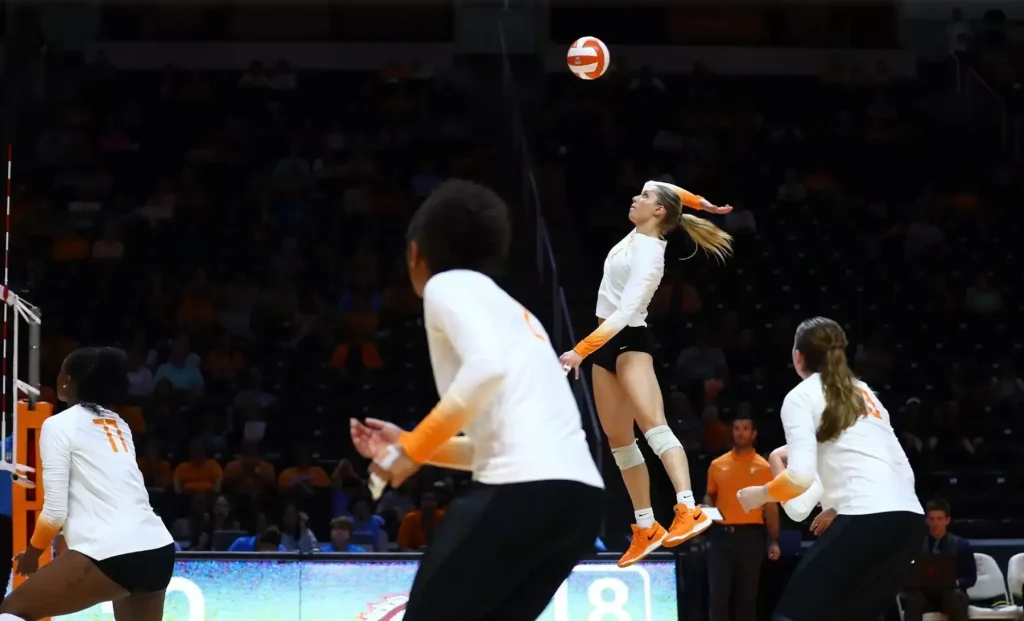
Fast-ball offenses in LOVB and VNL competition are increasingly built around one principle: score before the defense can close. The Bic — a quick, low-trajectory ball set tight to the middle blocker running a back-row attack — has become the single most effective way modern teams generate kills against a strong triple block. When the Bic is on time and the middle reads the release correctly, the ball is already past the ten-foot line before the right-side blocker can even begin their closing step. Triple block never forms. Kill.
When you’re running a quick-tempo attack — tight Bic in the middle, fast first-tempo ball — the block has almost no time to form a three-person wall. The ball is over the net before two blockers can align.
This is why middle blockers with elite hitting efficiency (.320+) are so valuable in LOVB and VNL systems: their attacks are designed to beat the block with timing, not with power. Understanding how your 5-1 or 6-2 offensive system creates quick-tempo opportunities helps you see how kill generation is a system outcome, not just an individual skill.
For attackers facing a pre-formed triple block: slow down. Vary your speed. And, if quick, use the tool. A triple block is nearly impossible to overpower; it’s very possible to outmaneuver with a roll shot or wipe. Power hitters who go directly into closed triple blocks are giving the defense exactly what they’ve trained to receive.
Kill vs. Block: The Statistical Divide
When your attack scores a point, you earn a kill. When you’re blocking and the ball rebounds off your hands back into the opponent’s court for a point, that’s recorded as a block — not a kill. The opponent who attacked into your block is charged with an attack error.
This distinction matters because it measures different skills. Kills measure offensive output. Blocks measure defensive presence at the net. A middle blocker who posts 4 kills and 5 blocks in a match has contributed 9 direct scoring plays — an excellent performance, even if the kill column alone looks modest.
One edge case: if you’re attacking and a blocker commits a violation (net touch, centerline crossing, illegal back-row block), you receive credit for a kill even if your ball didn’t score independently. The blocker’s error on your attack attempt gives you the point and the stat. If you want to understand how jump training directly raises your attack ceiling, the vertical training guide runs through the approach mechanics and plyometric progressions that feed directly into kill rate improvement.
Quick Reference: Kill Efficiency Benchmarks
| Level | Position | Good Efficiency | Elite Efficiency |
|---|---|---|---|
| High School | Outside Hitter | .200–.250 | .280+ |
| High School | Middle Blocker | .280–.320 | .360+ |
| College | Outside Hitter | .250–.300 | .330+ |
| College | Middle Blocker | .320–.370 | .400+ |
| Pro (LOVB/VNL) | Outside Hitter | .250–.280 | .300+ |
| Pro (LOVB/VNL) | Middle Blocker | .320–.350 | .370+ |
These are realistic targets for competitive play. Recreational leagues run lower across all positions because of lower pass quality and slower set tempo. If your recreational efficiency is at .200, you’re playing at a college-prep level.
FAQs on Kill in Volleyball
What is the difference between a kill and a spike in volleyball?
Kill and spike are both offensive actions in volleyball that involve jumping and striking the ball. A spike refers to the action of aggressively hitting the ball over the net with the intent to score or force an error from the opposing team.
On the other side, a kill is a successful spike that results in a point, meaning the ball either lands on the court or your opponent is unable to return it. All kills are considered spikes, but not all spikes will fall under kills.
How do you calculate a kill in volleyball?
To calculate the kill in volleyball, you count each successful attack that results in a point. The kill percentage is determined by dividing the kills by the attack attempts for a player.
Thus, if someone was awarded seven kills and attempted ten attacks, her kill percentage would be 70%. This metric helps in assessing the player’s effectiveness in scoring points and their overall contribution to the team’s offense.
What’s a good kill total for a high school outside hitter?
3–5 kills per set is a solid benchmark. Over a full five-set match, that’s 15–25 kills — a dominant performance at the high school level. Don’t chase raw numbers. Track your efficiency alongside kill totals.
Yes, a setter can achieve a kill by performing a “setter dump.”
It occurs when the passer makes the perfect pass, and the setter goes up with two hands like they’re about to set a hitter but instead quickly pushes or tips the ball over the net, catching the opposing team off guard.
This surprise attack is a strategic move that requires good timing and awareness of the opponent’s positioning.
Yes. When you redirect the ball off the blocker’s hands and it lands out of bounds, you earn the kill and the blocker’s team absorbs an attack error. The ball going out of bounds on a block-out counts as your offensive success.
Rarely, and only in very specific situations. Liberos cannot attack the ball above net height from the front zone, and they’re not usually set from back row. In theory, a libero who attacks legally from behind the three-meter line and scores earns a kill. In practice, this almost never happens.