My sophomore year of college, I was playing four or five times a week and my pass rating wasn’t moving. Same shanks off tough floaters, same hesitation reading the setter. My position coach finally said something that rewired my thinking: “Ryan, you’re playing a lot. You’re not training at all.” He pulled me out of pickup for two weeks and had me do nothing but serve receive reps against a wall and targeted platform drills with a partner. Two weeks of boring, isolated, sometimes embarrassing work. When I came back to live play, my passing had jumped from a consistent 1.8 to a 2.3 on the 3-point scale.
If you’re playing three or four times a week and feel like you’re running on a treadmill, I’ve been there. The gap between “playing a lot” and “training deliberately” is where most players get stuck, and it’s exactly what this guide is built to fix. Below is the 8-stage roadmap I wish someone had handed me before I wasted months grinding without a plan.
The 8-Stage Volleyball Improvement Roadmap
| Stage | Name | What You Actually Do | Typical Timeline | Main Focus | Before Moving On |
|---|---|---|---|---|---|
| 1 | Honest Assessment | Film yourself, run simple skill tests, get coach or teammate feedback | 1 week | Self-awareness | Can you identify your 2 weakest skills? |
| 2 | Pick Your Focus | Choose 1 primary + 1 secondary weakness for the next block | 1 week | Prioritization | Are your chosen skills specific enough to drill? |
| 3 | Fundamentals Lock | Master basic contact: passing platform, standing float serve, setting footwork | 4-6 weeks | Consistency over power | Can you bump 8 out of 10 passes to the target zone? |
| 4 | Skill Building | Higher reps, tougher serves, realistic ball trajectories | 6-8 weeks | Volume with feedback | Can you serve 7 out of 10 floats in-bounds with a target? |
| 5 | Position Layer | Train for your role: OH approach, libero reads, setter tempo | 4-6 weeks | Role clarity | Do you know your responsibilities in all 6 rotations? |
| 6 | Game Application | Scrimmages with specific goals, pressure drills with consequences | Ongoing | Transfer to matches | Can you execute under scoring pressure? |
| 7 | Physical Prep | Jump mechanics, landing safety, shoulder health, core work | Ongoing, 2x per week | Injury prevention + power | Can you land a jump safely on one leg? |
| 8 | Review and Reset | Measure progress, adjust goals, pick next focus area | Every 6-8 weeks | Reflection | What improved? What's the next priority? |
Most players skip straight to stage 4 or 5 and wonder why they plateau. Follow the sequence. Each stage builds the foundation for the next.
Why You Feel Stuck (And Why That’s Normal)
Every volleyball community online has the same post. “I play three times a week and I’m not getting better.” “I’ve been at the same level for a year.” “I watch YouTube drills but nothing changes in games.”
Here’s what’s actually happening: you’ve fallen into what I call The Autopilot Trap. You show up, you play, you go home. The rallies blend together. You make the same passing errors in the same rotations. You swing at the same sets from the same angle. Nothing about the session forced you to confront a specific weakness, so nothing changed.
Playing is not training. Playing is repetition of your existing habits, good and bad. Training is isolating one specific mechanic, drilling it past the point of comfort, and measuring whether it improved. A player who spends 20 focused minutes on serve receive angles three times a week will improve faster than a player who plays full games for two hours every night. The difference is intent.
The good news is that plateaus are a documented stage of motor learning, not evidence that you’ve hit your ceiling. Research from Fitts and Posner’s three-stage motor learning model confirms that your brain consolidates skills from conscious effort into automatic response. That transition feels like stagnation, but it’s actually the system rewiring itself. The players who push through with targeted, specific training come out the other side faster and more consistent.
If you’ve been stuck, the answer is almost never “play more.” It’s “play less, train more, and train something specific.”
The Honest Assessment: Where Are You Right Now?
Before you pick a training focus, you need an accurate picture of your current game. Not what you think you look like. What you actually look like.
I call this The Diagnostic Loop: film yourself, watch the footage, identify one specific mechanic that’s off, drill it, then film again to check. Most players try to fix results (“the ball went out”) when they should be fixing mechanics (“my elbow dropped two inches on the follow-through”). The gap between what you think your body is doing and what it’s actually doing is enormous until you see it on video.
You don’t need a professional camera setup. Have a teammate prop a phone behind the endline during a scrimmage, or set it on a chair at the side of the court for a few rallies. When you rewatch, look for three things: where your feet are when you contact the ball, where your platform or hands are angled, and whether your body is square to your target.
Run a few simple diagnostics against yourself.
For serving: can you land 7 out of 10 standing float serves in bounds with a target zone?
Passing: on a scale of 0-3, are you delivering a 2-pass (hittable ball to the setter’s hands) at least 70% of the time?
Attacking: are you putting the ball away on more swings than you’re sending into the net or out of bounds? If you don’t know your hitting efficiency numbers, that stat alone will tell you more about your offensive game than hours of guessing.
Ask coaches and teammates to watch you during live play and give specific feedback. Not “you’re doing great” or “work on passing.” Ask them: “Where is my platform angled on out-of-system balls?” or “Am I cheating forward on serve receive?” Specific questions get specific answers. Broad questions get polite non-answers.
Once you’ve done this, you’ll have a clear list of 3-5 things that need work. Pick the top two. That’s your training block.
Build Your Training Blocks (Not a Random Drill List)
Random drills produce random improvement. The players who actually get better commit to what I call Training Blocks: 4-6 week periods where one technical theme shows up in every single session. If your block is “serve receive,” then every warmup, every partner drill, every pre-scrimmage sequence involves passing off live serves. You don’t touch jump serving technique during this block. And, don’t work on your setter hands. You pass. That’s it.
This feels restrictive, and it should. The point of a training block is depth on one skill, not a surface pass across many. After 4-6 weeks, you’ll have logged enough focused reps that the improvement sticks, and then you rotate to your next priority.
If you have team practice twice a week, use those sessions for the team structure your coach runs, then add one solo or partner session focused exclusively on your block. Before team practice starts, arrive 15 minutes early and run targeted passing repetitions against a wall or with a partner. That’s 45 extra minutes of focused work per week that your teammates aren’t getting.
If you mostly play pickup or open gym, the structure changes. Set a specific goal for each session before you walk in the door. “Tonight I’m going to call every ball in serve receive before I move” or “I’m going to serve to zone 1 every time I’m behind the line.” Write it on your hand if you have to. Without a pre-set intention, open gym becomes the Autopilot Trap all over again.
Here’s what a realistic week looks like for someone who can train 3-4 days:
Day 1 (Solo, 30-40 min): Isolated skill work on your block focus. If you’re in a serve receive block, that’s 50 wall passes for accuracy, 30 partner serve receive reps if you can find someone, and 20 self-toss overhead passes. Every rep has a target. Every miss gets noted.
Day 2 (Conditioning + footwork, 25-30 min): Volleyball-specific conditioning paired with movement patterns. Lateral shuffles to a block position, crossover steps to a defensive base, transition footwork from back row to the net. This isn’t a gym workout. It’s court movement with a heart rate.
Day 3-4 (Live play, 1.5-2 hours): Open gym or team practice where you carry your block focus into the game. Before you walk in, write your one focus on your hand or in your phone: “Track where every serve receive pass lands tonight.” After the session, write one observation. That two-sentence journal entry does more for your development than the two hours of play.
The ratio matters more than the volume. Two hours of unfocused play is worth less than 30 focused minutes of isolated work. And the isolated work is what makes the live play productive, because now you have something specific to test.
The Core Skills: Where to Start and What to Fix First
Every skill in volleyball feeds the next. A serve creates a pass, a pass creates a set, a set creates an attack, and the defense resets the cycle. If you’re not sure where to start training, follow the ball.
Passing and Serve Receive
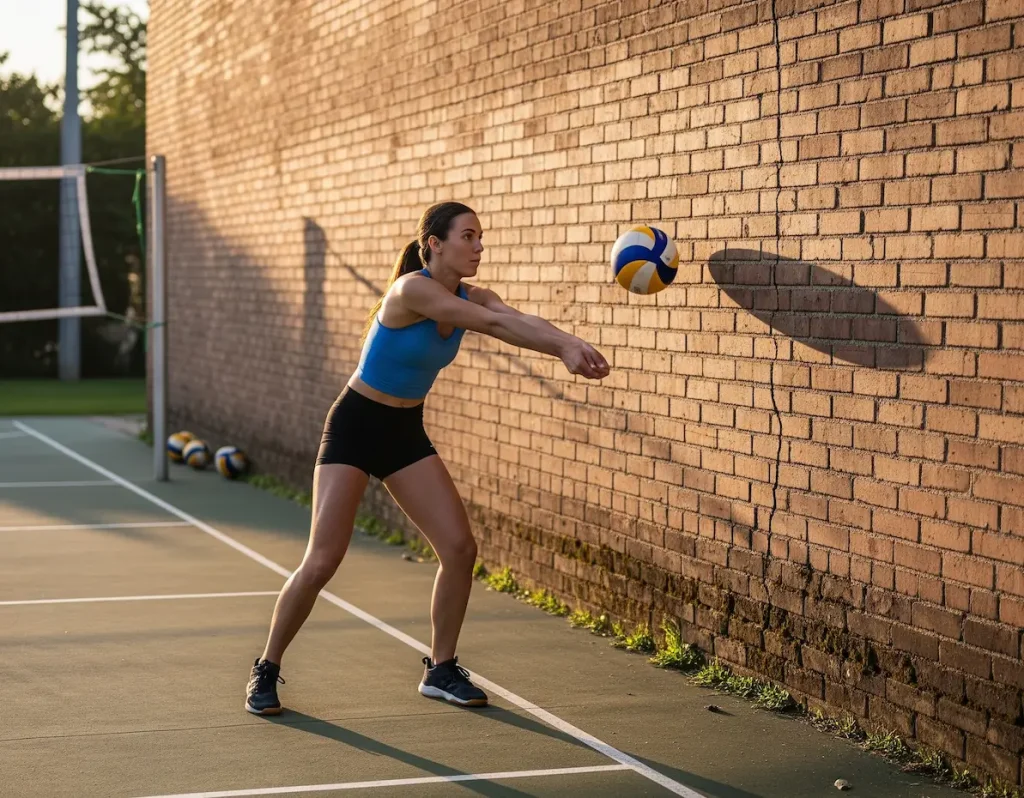
Passing is the most important skill you’ll ever develop, and the one most players undervalue. If your platform can’t deliver a clean ball to target, nothing else in the offense works. The serve receive pass is where most rec and club-level rallies break down, and it’s the first thing I’d train if I were starting over. Your feet should do 90% of the work getting you behind the ball. Your arms do the last 10%.
Serving With a Plan
A serve that just clears the net is a free ball for the other team. Serving with a target zone changes the math entirely. Pick a zone, pick a trajectory (short, deep, seam), and execute. Once you can reliably put a standing float where you want it, you’re already ahead of most rec players. Turning a serve into a direct point is about placement and unpredictability, not just power.
Setting Decisions
The difference between a good setter and a body moving the ball around is decision-making. When you study the setting position, focus less on hand shape and more on where you’re delivering the ball and why. Are you setting the hot hitter? Are you going away from the block? Tempo and target selection matter more than pretty hands.
Attacking and Approach Timing
Your approach creates your power, not your arm. The three- or four-step approach builds momentum so your body does the work your shoulder shouldn’t have to do alone. What I call “The Hitting Triangle” is the relationship between your approach angle, your arm swing path, and your contact point. Change one corner and the ball goes somewhere completely different. If you’re hitting into the net or out the back line, the fix is almost always in your feet, not your hand. Dig into approach timing and arm swing mechanics before you worry about hitting harder. Track your kill efficiency to see if your swings are actually producing points.
Blocking and Net Defense
Stop watching the ball and start watching the setter’s hands and the hitter’s shoulders. That’s the entire read. By the time you see the ball leave the hitter’s hand, you’re too late. Good blocking starts with a read, not a jump. Penetrate your hands over the net and angle them toward the court. A block that goes straight up is just a rebound for the other team.
Floor Defense and Digging
A dig isn’t a reaction. It’s a read that starts before the hitter contacts the ball. Watch the hitter’s shoulder rotation and arm angle to predict where the ball is going, then move your feet to get your platform behind it. The biggest mistake in floor defense is lunging with your arms instead of moving with your feet. Your platform should be stable and angled when you contact the ball, not swinging.
Choose Your Position (Then Train Like It)
If you’re past the beginner stage and still playing “wherever coach puts me,” it’s time to choose a direction. Every volleyball position has a different training path, and trying to be good at everything guarantees you’ll be great at nothing.
A rough diagnostic: if you’re tall with good timing and you like being at the net, look at middle blocker or opposite. If you’re quick, low to the ground, and love chasing balls, the libero or defensive specialist path might fit.
Whereas, if you’ve got a strong arm, decent passing, and you want to do a bit of everything, outside hitter covers the widest range of responsibilities.
And then, if you love running the show and can process information faster than the play develops, setter is the position that controls the entire offense.
Once you pick a direction, your training blocks shift to match. A middle blocker needs fast feet and explosive lateral movement at the net, not hours of serve receive. Their training block might focus entirely on read-and-react footwork along the net, timing their jump off the setter’s hands rather than the ball. A libero needs to own the back row from every rotation and read every hitter on the other side of the net. Their block is all platform work, defensive positioning, and serve receive under pressure. A setter’s block is footwork to the ball and decision speed: where am I delivering, and can I get there before the pass arrives?
If your team runs a 5-1 offensive system, knowing your responsibilities in all six rotations is non-negotiable. Half the errors in intermediate volleyball come from players who don’t know their “address” in each zone. You can’t improve at your position if you’re spending mental energy figuring out where to stand.
Closing the Warmup-to-Game Gap
You pass clean in warmups. You hit well in pepper. Then the whistle blows, the score matters, and your body forgets everything it knows. This is the pressure performance gap, and it’s one of the most common frustrations in volleyball.
The reason is straightforward: warmups and drills are low-stakes, predictable environments. Your brain is calm, your timing is grooved, and nothing unexpected happens. Games are the opposite. The crowd is loud, the serve is tougher than what your partner was tossing, and your heart rate is 30 beats higher than it was during pepper. Your motor patterns, which were built in a calm environment, can’t hold up under stress they’ve never been exposed to.
The fix is to train under pressure before you play under pressure. Add consequences to your drills. If you miss two serves in a row during practice, the entire group does five burpees. If your team drops below 70% passing in a serve receive drill, you reset the count to zero. Keep score in every small-sided game, even 2v2 on a half court. The more often your body executes with something on the line, the less the game environment feels like a shock.
The mental side matters just as much. I teach something I call The 8-Second Reset. In 2026 competitive volleyball with the 15-second service clock (now standard across PVF, LOVB, and many NCAA programs), you don’t have time to sulk after a bad play. You have roughly 8 seconds between the end of one rally and the next serve. In those 8 seconds, you need to let the last play go completely. One deep exhale, reset your feet to ready position, and lock your eyes on the server. If you’re still replaying the shank in your head when the next ball crosses the net, you’ve already lost two rallies instead of one.
The players who perform well in matches aren’t more talented than the players who fall apart. They’ve trained their reset speed. And that’s a skill you can practice every single session.
The Adult Beginner Progression
If you picked up volleyball after high school, or you’re coming back to the sport after years away, this section is for you. The most common thing I hear from adult beginners is some version of “everyone else has been playing since middle school and I feel like I’m years behind.”
You’re not as far behind as you think. Adults bring something to the court that teenagers don’t: the ability to train with intent. A 30-year-old who watches film, isolates weaknesses, and runs focused drills will close the gap on a 22-year-old who’s been playing casually since age 12 faster than either of them expects.
Here’s a realistic timeline for adults starting from scratch or returning after a long break:
Months 1-3: Learn the basic rules of play, develop a consistent underhand or standing float serve, build a forearm passing platform that can get the ball to the setter’s general area, and start understanding court zones and spacing. You won’t feel confident yet. That’s normal. The goal at this stage is contact consistency, not competition.
Months 3-9: Join a rec league. Your serve should be reliable enough that you’re not missing more than 2 out of 10. Your passing should be directional, not just “up.” You’ll start to see the court differently, reading where the ball is going before it gets there. This is when you pick a position direction and begin focused work.
Months 9-18: Refine role-specific skills. If you chose libero, your defensive reads should be improving week over week. If you went outside hitter, your approach timing should produce a consistent attack. You’ll still have rough games. Everyone does. But the trajectory is visible now, and the moments where you surprise yourself will become more frequent.
The biggest trap for adult beginners is comparing their month 6 to someone else’s year 10. You didn’t start at the same time. You don’t need to be at the same place. Track your own progress against your own baseline, and watch the Diagnostic Loop footage from month 1 when you’re feeling discouraged at month 6. The difference will be obvious.
One genuine advantage adults have: you can learn volleyball terminology and tactical concepts faster because you’re used to studying. Most teenagers absorb game sense through years of repetition. Adults can shortcut some of that by watching matches analytically, reading position guides, and understanding systems before they walk onto the court.
Training Without a Full Team
Not having a training partner or a full squad isn’t an excuse. Some of the most productive training sessions I ever had were alone in a gym with a ball and a wall.
Wall passing progression: Start with 50 consecutive forearm passes to yourself off the wall, standing about 8-10 feet back. Mark the net height on the wall with tape and keep every contact above that line. Once you can do 50 straight without dropping, move to angle work: stand at 45 degrees to the wall and pass to a target spot, alternating left and right. This builds directional control that transfers directly to serve receive.
Wall setting drill: Set continuously off the wall while standing still. Once that’s comfortable, set while moving forward and backward, keeping the same contact height. Inconsistent footwork is the number one setting error, and this drill exposes it immediately.
Solo serve practice: All you need is a ball and a net (or a park fence with the net height marked). Set up cones or targets in zones 1, 5, and 6. Take 30 float serves and track how many land in each zone. Structured beginner drills like these create measurable, repeatable sessions you can run by yourself.
Partner drills (if you have one): Pepper is fine for warmup, but it’s not training unless you add structure. Try a modified pepper where the set always goes to a specific spot, or where every third ball is a down-ball attack to a target. Short-short-deep defense drills (partner tips twice, then drives the third ball deep) build the read-and-react cycle that matters in games. Serve receive reps with a partner who can float serve are worth more than almost any other two-person drill.
Physical Prep Without the Gym Bro Routine
Volleyball beats up your body in specific ways: repetitive jumping loads your knees and ankles, overhead swings stress your shoulders, and floor defense puts your hips and wrists through strange angles. Training for volleyball doesn’t look like a bodybuilding program. It looks like injury prevention plus targeted power.
Start with jumping mechanics and landing safety. Before you add any plyometric volume, learn to land. A controlled landing on two feet with your knees tracking over your toes and your hips absorbing the impact is the foundation. Only after you can land safely on one leg should you progress to box jumps and depth jumps. Most ACL injuries in volleyball happen on landing, not on takeoff.
Shoulder health is the other non-negotiable. If you’re hitting and serving regularly, your rotator cuff and scapular stabilizers need maintenance work. External rotation with a band, face pulls, and overhead carries are enough for most recreational players. You don’t need a complex program. You need 10 minutes of shoulder prep before every session and you need to actually do it consistently.
For general strength, focus on squats, hip hinges (deadlifts or kettlebell swings), push-ups, and rows. Two sessions per week of 20-30 minutes is enough to support your volleyball training without wearing you out. Your gym work should make you more durable on the court, not leave you too sore to play.
Rest is training too. If you’re playing 4-5 times a week and lifting twice, you need at least one full rest day. Sleep is where your body actually consolidates the motor patterns you’ve been drilling. Eight hours is not optional for serious athletes. It’s when the improvement happens. The American Academy of Sleep Medicine recommends 8-10 hours for teen athletes specifically because of how sleep affects motor learning and recovery.
Track Your Progress (Or You’re Guessing)
Without measurement, you’re relying on feel. And feel is unreliable. The player who “feels like” they’re passing better might just be facing weaker serves this week.
Here’s how to know where you actually stand. Find your level, then train toward the metric that matches it.
| Level | Main Focus | Key Metric to Track |
|---|---|---|
| Beginner | Contact Consistency | 0-3 Pass Rating: Can you deliver a 2-pass 80% of the time? |
| Intermediate | Rotational Intelligence | Overlap Awareness: Do you know your "address" in all 6 zones? |
| Advanced | Tactical Disruption | FBSO%: Are you breaking the opponent's first-ball side-out pattern? |
| Elite | Mental Recovery Speed | The 8-Second Reset: Can you clear a shank before the next whistle? |
If you’re honest about where you land on this table, the metric column tells you exactly what to measure next. A beginner tracking FBSO% is looking at the wrong scoreboard. An advanced player who still can’t pass a 2.0 average has a hole in the foundation that no amount of tactical work will cover.
Start simple. Keep a notebook or a Google Sheet with three columns: date, what you worked on, and one measurable result. “Serve receive, 50 reps, 38 to target zone” is specific enough to track over time. “Worked on passing, felt okay” is not.
As you get more serious, track metrics by level. Beginners should watch their pass rating trend (0-3 scale). Intermediate players should track serve percentage (serves in vs. serves missed) and first-ball sideout rate during scrimmages. Advanced players should calculate their hitting percentage and defensive dig success rate to see where efficiency is actually improving.
Film review should be part of your tracking cycle. Record one scrimmage per week, even just a partial set on a phone. Watch it within 24 hours. Pick one mechanic to focus on in the next session. That’s the Diagnostic Loop completing its cycle, and it’s the fastest way to bridge the gap between what you think you’re doing and what you’re actually doing.
Your game score sheets can tell you things about your team’s patterns that no amount of in-game feel will reveal. Side-out percentages by rotation, serve error runs, and scoring droughts all become visible when you look at the data after the match instead of relying on memory.
FAQs
How long does it take to get good at volleyball?
It depends entirely on what “good” means for your goals and how deliberately you train. A complete beginner who trains with intent (not just plays) can compete in a recreational league within 3-6 months and hold their own in an intermediate league within 12-18 months. Reaching a competitive club level typically takes 2-4 years of consistent, structured training. Players who started young and trained through high school have a 5-8 year head start on motor patterns, but adults who train deliberately can close that gap faster than most people expect.
Is playing pickup enough to improve?
Pickup and open gym are great for reading live situations, building game sense, and getting comfortable on the court. But they won’t fix specific weaknesses because you rarely encounter the same situation enough times to build a new motor pattern. Think of pickup as the “test” and solo or structured training as the “study.” You need both, but the study is where the improvement actually happens.
Wall passing progressions (forearm and overhead), solo serving to target zones, and self-set-and-catch sequences for hand positioning. If you have access to a gym with a net, serve-and-shag drills (serve 10, collect, repeat) build volume quickly. The wall is your most versatile training partner because it gives immediate, honest feedback on every contact.
Fear of the ball is a contact confidence issue, not a courage issue. Your body flinches because it hasn’t built enough reps to trust that a proper platform absorbs the impact safely. Start with softer balls or lighter contacts at close range, and gradually increase speed and distance as your body learns that correct form protects you. Most players who are afraid of the ball are also letting the ball come to them instead of moving behind it, which leads to awkward contacts that actually do hurt. Fix the footwork first, and the fear usually resolves itself within a few weeks of consistent reps.
Your improvement plan doesn’t need to be complicated. Pick one skill from this roadmap, choose one drill that targets it, and schedule three sessions this week. Write down what you’re going to work on before each session, and write down one thing you noticed afterward. That’s it. That’s the whole system.
The court is waiting. Now go train, not just play.
Keep serving, Ryan Walker
I’m playing pickup three or four times a week and my passing still isn’t getting better. What am I missing?
Hey Mia, you’re playing a lot but probably not training, and that’s a real difference, I learned it the hard way in college. Pickup reps don’t isolate your weak spots; you just repeat what you’re already comfortable with. Block out time for targeted work: serve-receive reps against a wall, platform drills with a partner, and actually track a pass rating so you can see movement. Two weeks of boring, isolated passing work took me from a 1.8 to a 2.3 on the 3-point scale. Train the skill on purpose, then let pickup be where you apply it.