As we get better with practice, we develop a muscle memory of our plays. And it depends a lot on fixed part of court lines and net height.
There is a specific sound every hitter dreads: the muffled thud of a ball driving straight into the top tape because your timing was off by just half an inch. I learned the hard way at a high school regional tournament that ‘close enough’ doesn’t work in volleyball. We spent an hour warming up on a net that was accidentally set two inches high. As a 6’0″ outside hitter, I felt like I was jumping in quicksand.
There are two things that I learnt that day. In volleyball, a single centimeter is the difference between a ‘kill’ and a ‘net violation. And if the net height is off, your muscle memory is useless.
Here are the 2025-2028 official standards, down to the fraction of an inch, so you never have to ‘eyeball’ your setup again.
You can also use the approximate volleyball net height calculator (also a table below):
Volleyball Net Height Calculator [2026]
Volleyball Net Height Calculator [2026]
Notes & Official Sources
Center-Court Rule: Height must be measured at center court. The sidelines may be up to 2cm higher but never lower than the official mark.
Note: Some youth organizations (JVA/AAU) use a 1.98m (6’6″) net for 10U boys.
Notes & Official Sources
Rule Cycle: 2025-2028 FIVB/USAV/NCAA Standards. Center-Court Rule: Height must be measured at center court. The sidelines may be up to 2cm higher but never lower than the official mark. Note: Some youth organizations (JVA/AAU) use a 1.98m (6’6″) net for 10U boys.
The standard height of a volleyball net
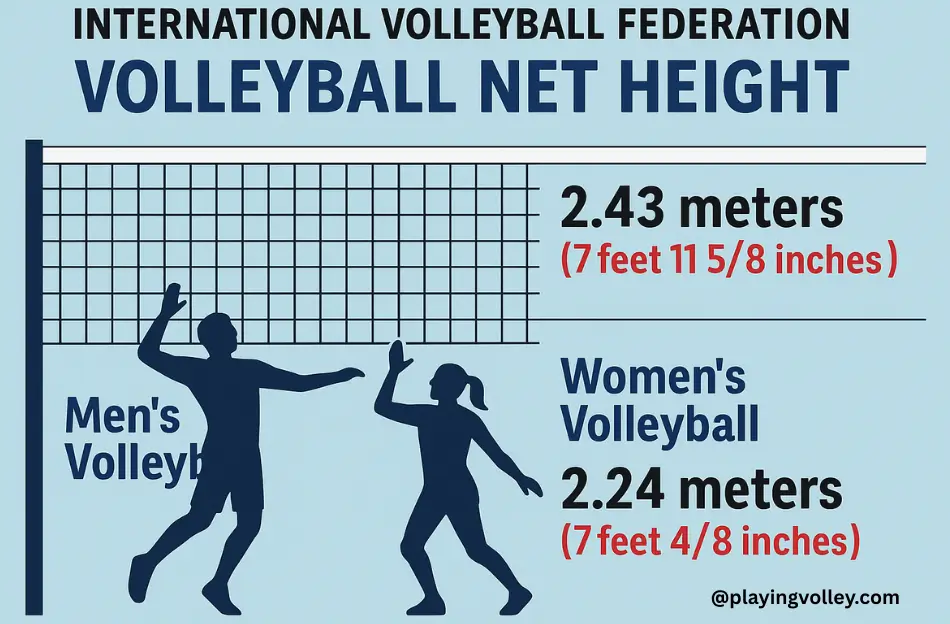
Quick Reference: Official Volleyball Net Heights
| Category | Net Height (Metric) | Net Height (Imperial) |
|---|---|---|
| Men (Adult / College / HS Varsity) | 2.43 m | 7′ 11 5/8″ |
| Women (Adult / College / HS Varsity) | 2.24 m | 7′ 4 1/8″ |
| Boys 15U-18U | 2.43 m | 7′ 11 5/8″ |
| Boys 13U-14U | 2.24 m | 7′ 4 1/8″ |
| Boys 10U-12U | 2.13 m | 7′ 0″ |
| Girls 13U-18U | 2.24 m | 7′ 4 1/8″ |
| Girls 11U-12U | 2.13 m | 7′ 0″ |
| Girls 10U | 2.00 m | 6′ 6 3/4″ |
| Sitting Volleyball (Men) | 1.15 m | 3′ 9 5/16″ |
| Sitting Volleyball (Women) | 1.05 m | 3′ 5 3/8″ |
*Note: Some youth organizations (JVA, AAU, and certain USAV regions) use a 1.98m (6′ 6″) net for 10U boys to encourage longer rallies at the youngest levels. Always confirm with your specific league.
Source: FIVB Official Rules 2025-2028, USAV Domestic Competition Regulations
The official net height for men is 2.43m (7′ 11-5/8″) and for women is 2.24m (7′ 4-1/8″).
These heights are recognized by FIVB (International Volleyball Federation), NCAA, USAV, and virtually every competitive volleyball organization worldwide.
That 19-centimeter gap (about 7.5 inches) between men’s and women’s heights isn’t arbitrary. It’s calibrated to create similarly competitive games given the average height and jumping ability differences between male and female athletes. At 2.43m, a 6’4″ male outside hitter with a 36-inch vertical can still get his hand above the tape with room to angle down. Drop that same player onto a 2.24m net, and every attack becomes an uncontested kill. Raise the women’s net to 2.43m, and college-level rallies would shrink to three-touch-and-out sequences with almost no terminated attacks.
For coed recreational volleyball, most leagues use the women’s height of 2.24m. However, competitive coed leagues sometimes use the men’s height. Always check with your league organizer before setting up.
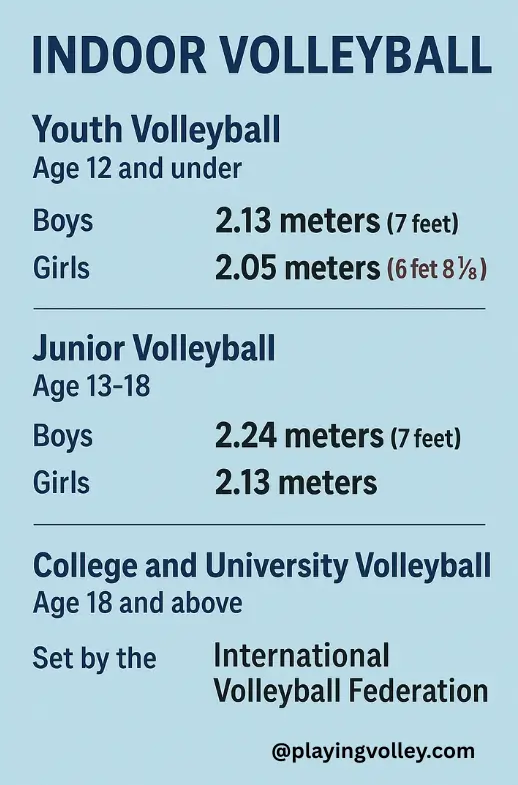
Youth volleyball net heights (USAV/AAU standards)
Youth net heights are designed to match developing athletes’ physical capabilities while teaching proper technique. Here’s the complete breakdown based on USAV and AAU regulations:
Boys indoor net heights
| Age Division | Net Height | Notes |
|---|---|---|
| 10U | 2.13 m (7′ 0″)* | *Some leagues use 1.98m (6′ 6″). See note below |
| 11U, 12U | 2.13 m (7′ 0″) | Transition height for developing players |
| 13U, 14U | 2.24 m (7′ 4-1/8″) | Same as adult women’s height |
| 15U, 16U, 17U, 18U | 2.43 m (7′ 11-5/8″) | Full adult men’s height |
Important 10U note: While USAV standards list 2.13m (7′ 0″) for 10U boys, many youth organizations including JVA and certain AAU regions have adopted a 1.98m (6′ 6″) net height for 10U boys, matching 10U girls, to encourage longer rallies and proper skill development at the youngest levels. Always verify with your specific league or tournament director.
The jump from 14U to 15U is the largest net height transition in youth volleyball. Boys move from 7′ 4-1/8″ to 7′ 11-5/8″, a gain of over 7 inches in a single age division. USAV specifically cites this gap in their age definition policy: boys born in the older year of a 14U age bracket who are still in 8th grade can receive a regional waiver to play down in the 14U division, specifically because of the net height difference. That waiver exists for no other age transition.
Girls indoor net heights
| Age Division | Net Height | Notes |
|---|---|---|
| 10U | 2.00 m (6′ 6-3/4″) | Lowest youth height |
| 11U, 12U | 2.13 m (7′ 0″) | Transition height |
| 13U, 14U, 15U, 16U, 17U, 18U | 2.24 m (7′ 4-1/8″) | Adult women’s height |
Girls begin playing at adult women’s net height at age 13, while boys don’t reach adult men’s height until 15. This reflects the different physical development timelines and the 19cm gap between men’s and women’s regulation heights.
Grade-level considerations: a common parent question
One of the most frequent questions I get from parents involves the overlap between age-based and grade-based play. Here’s the clarification that USAV provides:
For boys: A 14-year-old who is in 7th grade can sometimes receive a waiver to play “down” in the 13U division. However, this doesn’t change the net height, since both 13U and 14U boys play at 2.24m (7′ 4-1/8″). The grade exception primarily exists because the jump from 14U to 15U involves the 7-inch net height increase described above. A boy who is physically still developing in the 8th grade faces a real disadvantage jumping into a 7′ 11-5/8″ game. The waiver gives his body one more year to catch up.
For girls: The grade consideration is less impactful because girls at 13U and above all play at the same height (2.24m).
If you’re unsure whether your player qualifies for a grade-level exception, contact your regional USAV organization. The rules can vary slightly by region.
How to properly measure and set your net height
I’ve seen too many matches delayed, and a few even protested, because the net was “eyeballed” during setup. There’s nothing more frustrating than realizing halfway through the first set that the net is two inches lower in the middle than it is at the poles.
To set a professional-grade court, you need to understand what I call the “Center-Court Rule.”
The point of measurement (the middle matters)
According to FIVB Rule 2.1 in the 2025-2028 Official Volleyball Rules:
“Its height is measured from the centre of the playing court. The net height (over the two side lines) must be exactly the same and must not exceed the official height by more than 2 cm.”
While you might assume the net should be perfectly level from pole to pole, the rules actually allow for a slight “sag” toward the middle. The height at the two sidelines (above the boundary lines) can be exactly the same as the center, but it is technically allowed to be up to 2cm (approximately 3/4″) higher than the regulation height. It can never be lower than the official height at any point.
This 2 cm variance exists because even properly tensioned nets will sag slightly in the middle due to physics. The rule acknowledges this reality while maintaining competitive standards.
Between-set net height checks
A detail that most articles miss: captains and coaches can request a net height check between sets if they notice visible sag. The FIVB Refereeing Guidelines list “a rod to measure the height of the net” among required equipment for officials, and pre-match court inspection (including net height verification) is a documented second referee responsibility. If you’re coaching or playing and notice the net has loosened during a match, your captain can formally request a measurement check. At FIVB-level events, officials carry the tools and are expected to verify.
At club and high school levels, enforcement depends on the referees and equipment available. But knowing you can make the request is the first step.
Using the right tools
If you’re serious about your setup, put away the hardware store tape measure.
The Measuring Chain: Most professional net systems come with a pre-measured chain that hooks onto the top of the net and drops to the floor. When the weight at the end of the chain just barely kisses the court surface at the center of the court, you’re at the perfect height. Officials at all levels of competitive volleyball use this as the standard tool.
Telescoping Measuring Poles: These adjustable poles are marked with the official heights and provide a quick visual confirmation. They’re particularly useful for checking multiple points along the net.
If Using Adjustable Poles: Ensure the pin is fully locked into the correct height slot before you tension the top cable. Double-check that both poles are set to identical heights.
Tensioning vs. height: the coach’s secret
Beginners always miss this detail: tension affects height.
When you crank the winch to tighten the top cable, the center of the net will naturally rise. Here’s my approach after years of setting nets:
- Set the poles approximately 1/2″ higher than the target height
- Apply full tension until the net is “tight as a drum”
- Check the center height with your measuring tool
- If it’s too high, slowly release the winch until the center hits the mark
A properly tensioned net needs to be flat, not just tall enough. If the bottom of your net is flapping in the wind or sagging visibly, your net touches won’t be called fairly, and the ball won’t rebound correctly during a block. Tighten that bottom cable until the entire net is taut. I’ve had referees delay a match start over a loose bottom cable. It matters more than most coaches think.
The antenna check
Once your height is set at 2.43m (Men) or 2.24m (Women), you must align your antennae. The antennae are the vertical boundaries of the net, marking where the ball must cross to be in play.
The antennae must be placed directly above the outer edge of each sideline. If your net height is correct but your antennae are tilted or misplaced, you’re inviting a line-call nightmare during the match.
Beach volleyball
| Men’s Volleyball | 2.43 meters (7 feet 11 5/8 inches) |
| Women’s Volleyball | 2.24 meters (7 feet 4 1/8 inches) |
Youth beach volleyball heights typically follow these patterns:
| Age Division | Boys | Girls |
|---|---|---|
| 10U, 12U | 2.13 m (7′ 0″) | 2.13 m (7′ 0″) |
| 14U | 2.24 m (7′ 4-1/8″) | 2.24 m (7′ 4-1/8″) |
| 15U, 16U, 18U | 2.43 m (7′ 11-5/8″) | 2.24 m (7′ 4-1/8″) |
The primary difference in beach volleyball isn’t the net height. It’s the court size (16m x 8m vs. 18m x 9m for indoor) and the surface. Setting up a beach net requires additional attention to the sand conditions and anchor stability. Wind affects beach nets more than indoor nets, so you’ll need to re-check your center height more frequently during outdoor play.
Sitting volleyball net heights
Sitting volleyball is a Paralympic sport with its own specific net heights:
| Category | Net Height (Metric) | Net Height (Imperial) |
|---|---|---|
| Men | 1.15 m | 3′ 9-5/16″ |
| Women | 1.05 m | 3′ 5-3/8″ |
The court dimensions are also smaller at 10m x 6m instead of the standard 18m x 9m. The lower net combined with the smaller court creates a game where hand speed and lateral movement matter more than vertical reach. Attacks travel shorter distances, which means reaction time for defenders shrinks. Rallies tend to be quicker and more aggressive than casual observers expect.
Why net height changes how you play
As a 6’0″ outside hitter, those extra 7.5 inches between women’s and men’s net heights changed everything about my approach. At 7′ 4-1/8″, I could contact the ball well above the tape and angle aggressively into zone 5 or zone 1. At 7′ 11-5/8″, that same swing barely cleared the net, and I had to rely on a higher contact point and steeper approach angle just to keep the ball in play.
Here’s how net height shifts each core skill:
Attacking requires more explosive jumping ability at the men’s height, and the attack angle becomes steeper. At 2.24m, a hitter with an average vertical can still get above the tape and hit with options. At 2.43m, that same hitter needs to contact the ball at a higher point, which means jumping earlier, reaching higher, and generating power from a more extended arm position. The margin between a kill and a ball in the net narrows. If you’re consistently getting stuffed by the tape at men’s height, training your vertical jump specifically for net clearance will close the gap faster than any technique tweak.
Blocking changes because net height determines how much of your body can extend above the tape. At men’s height, only middle blockers with elite reach and jumping ability can get their hands and forearms fully above the net. At women’s height, more players at each position can present a solid block, which makes blocking strategy more central to the defense.
Serving is less directly affected by net height, since the ball just needs to clear the tape. But the perception of that height matters. Jump servers calibrate their contact point differently at 2.43m versus 2.24m, and a float serve that barely clears a men’s net creates a different trajectory than the same serve over a women’s net.
Setting requires trajectory adjustments based on net height. A set that gives hitters a good attack angle at 7′ 4-1/8″ might be too low at 7′ 11-5/8″. Setters who play on both men’s and women’s nets (common in coed leagues) need to recalibrate their tempo sets every time the net height changes.
The training consistency problem
The mistake I made in that high school tournament, practicing at the wrong height, is more common than you’d think. If your gym doesn’t have accurate height markings, or if your portable net system isn’t calibrated properly, you could be building muscle memory for the wrong height.
My recommendation: always verify your net height before practice, not just before matches. Two minutes with a measuring chain before warmups costs nothing. Discovering your net has been 1.5 inches low for the past three weeks of practice costs you timing on every swing when you face a properly set net in competition.
High school volleyball net heights (NFHS)
High school volleyball in the United States follows NFHS (National Federation of State High School Associations) rules, which align with adult standards:
| Category | Net Height |
|---|---|
| Boys Varsity | 2.43 m (7′ 11-5/8″) |
| Girls Varsity | 2.24 m (7′ 4-1/8″) |
| Boys JV | 2.43 m (7′ 11-5/8″) |
| Girls JV | 2.24 m (7′ 4-1/8″) |
Middle school programs typically use the youth heights appropriate for the age group, though this can vary by state and league. Check with your specific athletic association for local requirements.
College volleyball net heights (NCAA)
NCAA volleyball uses the same heights as FIVB international standards:
| Division | Men | Women |
|---|---|---|
| Division I | 2.43 m (7′ 11-5/8″) | 2.24 m (7′ 4-1/8″) |
| Division II | 2.43 m (7′ 11-5/8″) | 2.24 m (7′ 4-1/8″) |
| Division III | 2.43 m (7′ 11-5/8″) | 2.24 m (7′ 4-1/8″) |
These heights are consistent across all three NCAA divisions. A D-III outside hitter who transfers to a D-I program faces the same 2.43m net on day one. The uniformity matters because it means every college player, regardless of division, develops timing and technique at the same measurement.
FAQs
Volleyball net height is always measured from the middle. Plus, the sides can’t be more than ¾ inch above the standard height.
The net height in professional volleyball is rigorously regulated to ensure competition is fair and consistent. Both the net’s width and tension must adhere to official regulations because any departure could alter the dynamics of the game.
For 12-year-old boys (12U), the standard net height is 2.13 meters (7′ 0″). For 12-year-old girls (12U), the height is also 2.13 meters (7′ 0″). These heights are set by USAV to match the physical development of players at this age.
Volleyball net height is always measured at the exact center of the court, not at the poles.
According to FIVB Rule 2.1.2, the height at the sidelines can be up to 2cm (¾”) higher than the center measurement, but never lower. Use a measuring chain or calibrated measuring pole for accurate results.
For 10U boys, the standard USAV net height is 2.13 meters (7′ 0″), though some youth organizations (JVA, AAU) use 1.98m (6′ 6″) to encourage longer rallies. For 10U girls, the net height is 2.00 meters (6′ 6¾”). Always verify with your specific league.
What net height is used for coed volleyball?
Most recreational coed leagues use the women’s net height of 2.24 meters (7′ 4⅛”). However, some competitive coed leagues use the men’s height. Always confirm with your league organizer before setting up.
Can I request a net height check during a match?
Yes. According to the 2025 FIVB Referee’s Manual, team captains can formally request a net height verification between sets if they notice visible sag. Officials are required to check and adjust if necessary.
Why is there a difference in height between men and women in volleyball?
The 19cm (7½”) difference between men’s (2.43m) and women’s (2.24m) net heights creates comparable competitive dynamics given the average physical differences between male and female athletes.
Setting Up Your Net: Step-by-Step Guide
- Position your poles at the correct distance—the net should span 9.5 to 10 meters, with the antennae marking the 9-meter court width at the sidelines.
- Set both poles to the same height using the height adjustment mechanism. Set them approximately ½” higher than your target to account for tensioning.
- Attach the net and hook the top cable to both poles.
- Tension the top cable using the winch or ratchet system until the net is taut.
- Measure at center court using a measuring chain or calibrated pole. Adjust as needed.
- Tension the bottom cable until the net hangs flat without sagging or flapping.
- Position the antennae directly above each sideline, ensuring they’re vertical and secure.
- Final verification: Check center height one more time and confirm antennae alignment.
Sources
- FIVB Official Volleyball Rules 2025-2028
- FIVB Refereeing Guidelines and Instructions 2025
- USAV Domestic Competition Regulations
- USAV Junior Player Age Definition 2025-2026
- AAU Volleyball Handbook
- NCAA Volleyball Rules
The net hieght calculator is real quick and accurate.
Setting up a net in the backyard for my two kids (13 and 11) and now I’m second-guessing myself lol. Men’s or women’s height so they can both use it?
Neither, honestly. Men’s is 7’11 5/8″ (2.43 m) and women’s is 7’4 1/8″ (2.24 m), and both are too tall for an 11-year-old to get a real swing over. For shared backyard reps, set it to a youth height around 7’0″ so both kids can actually attack and not just push the ball. The point of practice is clean contacts, not learning to scoop it over a net they can’t clear. When your 13-year-old starts playing on a 7’4 1/8″ net in a league, raise it to match so the training carries over.
Where are you supposed to measure net height, the center or the ends? Ours always sags a little in the middle.
Hey Holly, you measure at the center of the net, and that’s on purpose. The net is allowed to sit very slightly higher at the posts, but the center is the official height and the spot a ref checks. A net that sags in the center is reading low right where most attacking happens, which throws off everyone’s timing. The fix is tension: tighten it until the center holds the correct height, then confirm both halves are even. A good habit is to measure center first, every time, before warmups.
What height should my 11-year-old be practicing on? The regulation net looks way too tall for her age.
Hey Karen, you’re right to question it, full adult height is too high for that age and just trains bad habits. Youth net heights step down by age group specifically so kids can develop real attacking and serving mechanics. For the 10 to 11 range, the net is set well below the adult women’s height (which is 2.24m, about 7 feet 4 inches), then steps up as they get older until they reach full height in the early teens. Your league or club will publish the exact height for her age division, and the article has the youth chart plus a calculator. The principle: an age-appropriate net lets her learn to hit and serve correctly instead of just battling the height.
My daughter just bumped up to 7th grade and the net looks taller than last season. Do middle schoolers play a different height, or is it the women’s net the whole way up?
Good eye, and yes, it usually does change. Under USAV and AAU youth standards, 12-and-under often plays at 7’0″ (2.13 m), then most programs move kids up to the full women’s height of 7’4 1/8″ (2.24 m) around 13-14U, which is right when a lot of 7th graders land. So her net almost certainly went up this year. One catch: middle school leagues set their own rules, so check her specific league’s chart before you assume. The youth section above has the full grade-by-grade breakdown.