During my college volleyball years, I remember gathering with teammates to watch World League matches on whatever grainy stream we could find. There was something electric about seeing Brazil and Italy battle it out on the international stage—players executing at a level that made our own games feel like backyard scrimmages.
Those matches taught me more about high-level volleyball strategy than any practice session ever could. The World League represented the pinnacle of annual international competition, and for 28 years, it shaped how the world’s best teams prepared, competed, and evolved.
If you’re a volleyball fan who started following the sport after 2018, you might not even know this competition existed. The FIVB Volleyball World League ran from 1990 to 2017, crowning champions every single year and establishing dynasties that defined international volleyball. This guide covers everything: the Italian dominance of the 1990s, Brazil’s takeover in the 2000s, the competitive parity that emerged in the final years, and why the FIVB ultimately replaced it with the Volleyball Nations League.
World League Championships at a Glance
Here’s what you need to know about the three distinct eras of World League competition:
| Era | Period | Dominant Nation | Championships Won | Win Rate |
|---|---|---|---|---|
| Italian Dominance | 1990–2000 | Italy | 8 of 11 titles | 73% |
| Brazilian Ascendancy | 2001–2010 | Brazil | 8 of 10 titles | 80% |
| Competitive Parity | 2011–2017 | Multiple nations | 5 different winners | Distributed |
The complete all-time medal standings tell the story of global volleyball development over nearly three decades:
| Rank | Country | Gold | Silver | Bronze | Total Medals |
|---|---|---|---|---|---|
| 1 | Brazil | 9 | 8 | 6 | 23 |
| 2 | Italy | 8 | 5 | 4 | 17 |
| 3 | Russia | 3 | 5 | 6 | 14 |
| 4 | Cuba | 1 | 5 | 2 | 8 |
| 5 | Serbia | 1 | 3 | 2 | 6 |
| 6 | USA | 2 | 2 | 2 | 6 |
| 7 | Poland | 1 | 1 | 3 | 5 |
| 8 | France | 2 | 1 | 1 | 4 |
| 9 | Netherlands | 1 | 1 | 1 | 3 |
Brazil and Italy stand alone as the only two nations that participated in every single one of the 28 World League editions—a testament to organizational stability and consistent competitive excellence.
What Was the FIVB World League?
The FIVB Volleyball World League was the premier annual international men's volleyball competition from 1990 to 2017. Brazil holds the record for most titles (9), followed by Italy (8). The tournament was replaced by the Volleyball Nations League (VNL) in 2018.
The FIVB Volleyball World League was an annual international men’s volleyball competition created in 1990 as part of the Fédération Internationale de Volleyball’s aggressive marketing strategy. Unlike the quadrennial World Championships or Olympic Games, the World League offered elite national teams the opportunity to compete against top-tier opponents every single year.
The tournament operated on a home-and-away format, with teams hosting matches in their home venues before traveling to opponents’ countries. This structure created genuine home-court advantages and allowed fans worldwide to watch elite international volleyball without traveling to a central host location. The competition typically ran from May through July, fitting between club seasons and major international tournaments.
The tournament’s home-and-away format and prize money structure shaped international volleyball’s evolution for decades.
Yeah, it was its prize money. The inaugural 1990 edition offered $1 million USD in total prizes—an unprecedented sum for volleyball at the time. Combined with comprehensive television broadcasting across all participating nations, the World League elevated volleyball’s profile as a professional spectator sport.
The tournament expanded significantly over its 28-year run, growing from 8 teams in 1990 to a record 32 teams by 2015. The FIVB eventually replaced it with the Volleyball Nations League in 2018, but the World League’s legacy shaped international volleyball’s competitive structure and global reach.
The Italian Era: European Dominance (1990-2000)
The 1990s belonged to Italy. When the World League launched in 1990 with its inaugural tournament in Tokyo, Italy set the tone by defeating the Netherlands in the final, with Brazil claiming bronze. That victory established a pattern that would define the decade: Italian volleyball at its systematic, tactical best.
Italy won the first three World League titles consecutively (1990, 1991, 1992), immediately establishing themselves as the tournament’s benchmark team. The victories weren’t flukes—Italian volleyball had invested heavily in domestic infrastructure, and their Serie A league provided the world’s most competitive club environment. Players developed through rigorous competition against other elite professionals week after week, preparing them for international pressure.
The Italian dynasty featured exceptional individual talent that complemented their systematic approach. Andrea Zorzi earned MVP honors in both 1990 and 1991, establishing himself as the defining player of early World League history. Lorenzo Bernardi revolutionized the setter position and claimed MVP awards in 1992 and again in 1996. Andrea Giani provided versatility and earned the 1994 MVP, representing Italian volleyball’s tactical adaptability.
1990s Championship Results
| Year | Champion | Runner-Up | Final Score | MVP |
|---|---|---|---|---|
| 1990 | Italy | Netherlands | 3–0 | Andrea Zorzi |
| 1991 | Italy | Cuba | 3–0 | Andrea Zorzi |
| 1992 | Italy | Cuba | 3–1 | Lorenzo Bernardi |
| 1993 | Brazil | Russia | 3–2 | Giovane Gávio |
| 1994 | Italy | Cuba | 3–1 | Andrea Giani |
| 1995 | Italy | Brazil | 3–1 | Dmitriy Fomin |
| 1996 | Netherlands | Italy | 3–2 | Lorenzo Bernardi |
| 1997 | Italy | Cuba | 3–0 | Guido Görtzen |
| 1998 | Cuba | Russia | 3–1 | Osvaldo Hernández |
| 1999 | Italy | Cuba | 3–1 | Osvaldo Hernández |
| 2000 | Italy | Russia | 3–1 | Andrea Sartoretti |
Brazil’s 1993 championship marked the only non-Italian gold medal in the first four years, a breakthrough that foreshadowed their eventual takeover. Playing at home as reigning Olympic champions, Brazil defeated Russia in a five-set final that demonstrated South American volleyball was ready to challenge European supremacy.
The Netherlands’ 1996 victory proved particularly significant, foreshadowing what would happen just weeks later at the Atlanta Olympics. That upset in a dramatic five-set final showed that Italy’s dominance wasn’t absolute—though Italy would respond by winning in 1997, 1999, and 2000.
Cuba emerged as the decade’s most consistent challenger, reaching five finals and finally breaking through in 1998 for their only World League title. Osvaldo Hernández’s back-to-back MVP performances in 1998 and 1999 demonstrated Cuban volleyball at its peak, though they could never quite sustain championship-level consistency across multiple years.
Several factors converged to establish Italian supremacy during this era. Geographic advantage played a role—European location facilitated frequent international competition and reduced travel fatigue. The quality of Serie A meant Italian players faced elite-level volleyball 40+ weeks per year. And systematic coaching development created tactical approaches that other nations struggled to match. By decade’s end, Italy had claimed 8 of 11 titles, a 73% championship rate that seemed untouchable.
The Brazilian Ascendancy: South American Supremacy (2001-2010)
Everything changed in 2001. Brazil defeated Italy 3-0 in the World League final, claiming their second title and signaling a fundamental shift in international volleyball’s power structure. It wasn’t just a single victory—it was the beginning of the most dominant decade any nation has ever achieved in World League history.
Brazil’s rise coincided with their 2000 Sydney Olympics gold medal, which created momentum and confidence that translated directly into World League success. The Brazilian program under coach Bernardo Rezende (known as “Bernardinho”) combined systematic player development with tactical innovation that left opponents struggling to adapt.
From 2001 to 2010, Brazil won an astonishing 8 of 10 World League titles—an 80% win rate that exceeded even Italy’s 1990s dominance. The only interruptions came from Russia in 2002 and the United States in 2008, both of which proved to be exceptions rather than challenges to Brazilian supremacy.
2000s Championship Results
| Year | Champion | Runner-Up | Final Score | MVP |
|---|---|---|---|---|
| 2001 | Brazil | Italy | 3–0 | Ivan Miljković |
| 2002 | Russia | Brazil | 3–2 | Ivan Miljković |
| 2003 | Brazil | Serbia & Montenegro | 3–1 | Ivan Miljković |
| 2004 | Brazil | Italy | 3–2 | Gilberto Godoy Filho |
| 2005 | Brazil | Serbia & Montenegro | 3–2 | Ivan Miljković |
| 2006 | Brazil | France | 3–1 | Gilberto Godoy Filho |
| 2007 | Brazil | Russia | 3–1 | Ricardo Garcia |
| 2008 | USA | Brazil | 3–1 | Lloy Ball |
| 2009 | Brazil | Russia | 3–2 | Sérgio Santos |
| 2010 | Brazil | Russia | 3–1 | Murilo Endres |
The Brazilian roster featured generational talents that maintained excellence across the entire decade. Giba became the face of Brazilian volleyball, combining explosive attacking with leadership that set the standard for the position. Sérgio Santos revolutionized setting technique and earned the 2009 MVP. Murilo Endres provided consistent outside hitting and claimed the 2010 MVP honor.
Russia’s 2002 championship represented the sole non-Brazilian title during their dominant stretch. That victory established Russia as a genuine alternative to Brazilian supremacy and foreshadowed their increased competitiveness in the 2010s. Maxim Mikhaylov emerged during this period as a world-class outside hitter who would later lead Russia to multiple titles.
The 2008 USA victory stands out as particularly significant. The Americans defeated Brazil 3-1 in the final, breaking a six-year Brazilian championship streak. Lloy Ball’s MVP performance at libero raised USA’s competitive profile and provided momentum heading into the Beijing Olympics. This breakthrough demonstrated that North American volleyball had reached elite international standards.
Serbia (competing as Serbia & Montenegro through 2006) established themselves as consistent challengers during this era, reaching multiple finals without capturing gold. Ivan Miljković won three consecutive MVP awards (2001-2003) despite his team’s inability to claim championships, highlighting how individual excellence doesn’t always translate to team titles.
What sustained Brazilian dominance? Beyond individual talent, Brazilian volleyball had developed systematic pathways from youth programs to the national team. Club infrastructure expanded throughout the 2000s, providing professional opportunities that kept top players competitive year-round. The cultural significance of volleyball in Brazil—particularly after Olympic and World Championship success—attracted athletic talent that might have chosen other sports elsewhere.
Competitive Parity: Global Growth (2011-2017)
The final seven World League editions marked a fundamental shift in international volleyball. After two decades dominated by single nations, five different countries claimed championships between 2011 and 2017: Russia, Poland, USA, France, and Serbia. The era of guaranteed Brazilian victory had ended.
The 2011 World League final in Gdańsk, Poland, announced this new competitive reality. Russia defeated Brazil 3-2 in a thrilling five-set match (23-25, 27-25, 25-23, 22-25, 15-11), claiming their second World League title and ending Brazil’s championship exclusivity. Maxim Mikhaylov’s 26-point MVP performance established Russian volleyball at the world-class standard it would maintain throughout the decade.
2011-2017 Championship Results
| Year | Champion | Runner-Up | Final Score | MVP |
|---|---|---|---|---|
| 2011 | Russia | Brazil | 3–2 | Maxim Mikhaylov |
| 2012 | Poland | USA | 3–1 | Bartosz Kurek |
| 2013 | Russia | Brazil | 3–0 | Nikolay Pavlov |
| 2014 | USA | Brazil | 3–1 | Taylor Sander |
| 2015 | France | Serbia | 3–0 | Earvin N’Gapeth |
| 2016 | Serbia | Brazil | 3–0 | Marko Ivović |
| 2017 | France | Brazil | 3–2 | Earvin N’Gapeth |
Poland’s 2012 breakthrough came under coach Stéphane Antiga’s systematic approach. Bartosz Kurek’s MVP performance led Poland to their first and only World League title, demonstrating how Eastern European development programs had reached elite international standards. Though Poland never repeated as champions, their consistent competitiveness throughout the 2010s validated systematic investment in volleyball infrastructure.
The 2014-2016 stretch proved particularly significant for global volleyball development. The USA captured their first World League title in 2014, defeating Brazil in the final behind Taylor Sander’s MVP performance. France won their inaugural title in 2015, with Earvin N’Gapeth establishing himself as one of the world’s premier outside hitters. And Serbia finally broke through in 2016, defeating Brazil 3-0 in straight sets (25-22, 25-22, 25-21) after 27 editions of participation without gold.
Serbia’s championship drought had become one of volleyball’s most persistent narratives. They had accumulated 16 medals across World League history—mostly silver and bronze—without ever capturing the title. Marko Ivović’s MVP performance in the 2016 final represented vindication for a program that had consistently produced excellent teams without achieving ultimate success.
France’s 2017 victory in the final World League edition brought the tournament full circle. Defeating host Brazil 3-2 in a dramatic five-set final in Curitiba, France claimed their second title and demonstrated that European volleyball had diversified beyond Italian dominance. Earvin N’Gapeth earned his second MVP honor, cementing his status as the tournament’s final era-defining player.
Brazil reached the final in 2011, 2013, 2014, 2016, and 2017—five of the seven final editions—but won zero titles. This pattern illustrated how competitive depth had increased globally. Brazilian volleyball remained elite, but they could no longer guarantee championships through superior talent alone. Tactical innovation, strategic preparation, and match-day execution had become equally distributed across multiple top-tier programs.
How the Format Evolved Over 28 Years
The World League’s competitive structure evolved significantly from 1990 to 2017, reflecting FIVB’s efforts to balance elite competition with global development.
The inaugural 1990 edition featured 8 elite nations in a straightforward home-and-away round-robin format culminating in finals. This structure prioritized quality over quantity—the world’s best teams playing frequently against each other. Italy, Brazil, and the Netherlands immediately established themselves as the top tier.
Through the 1990s, participation expanded gradually to 10-12 teams while maintaining the core home-and-away structure. Cuba, Russia, and emerging European programs joined the regular rotation, increasing competitive depth without diluting quality.
The 2000s introduced the revolutionary multi-group system. By 2006, the tournament had standardized into three distinct groups. Group 1 featured 8 elite teams competing in the traditional intercontinental round plus finals. Group 2 included 12 competitive teams from developing volleyball nations. And, Group 3 provided 12 emerging nations with tournament-style competition and development opportunities.
This three-group structure served dual purposes. Elite nations maintained high-level competition without schedule bloat, while developing programs gained international experience without facing immediate elimination against superior opponents. The system directly supported FIVB’s global empowerment initiatives.
The intercontinental round for Group 1 teams involved approximately 12 matches played across three weeks, with each team hosting opponents in their home city and traveling for away matches. This created genuine home-court advantages—Brazilian teams playing in front of 12,000 passionate fans in São Paulo or Rio de Janeiro held legitimate competitive edges over visiting Europeans.
Finals rounds evolved through various formats: Top Six, Top Four, and the quarter-semifinal Olympic format. From 2004 onward, the most common structure organized quarterfinalists into two pools, with the top two teams from each pool advancing to semifinals and finals in an Olympic-style knockout.
By 2015-2017, participation peaked at 28-32 teams across all three groups, with finals held in rotating host cities including Rio de Janeiro (2015), Kraków (2016), and Curitiba (2017).
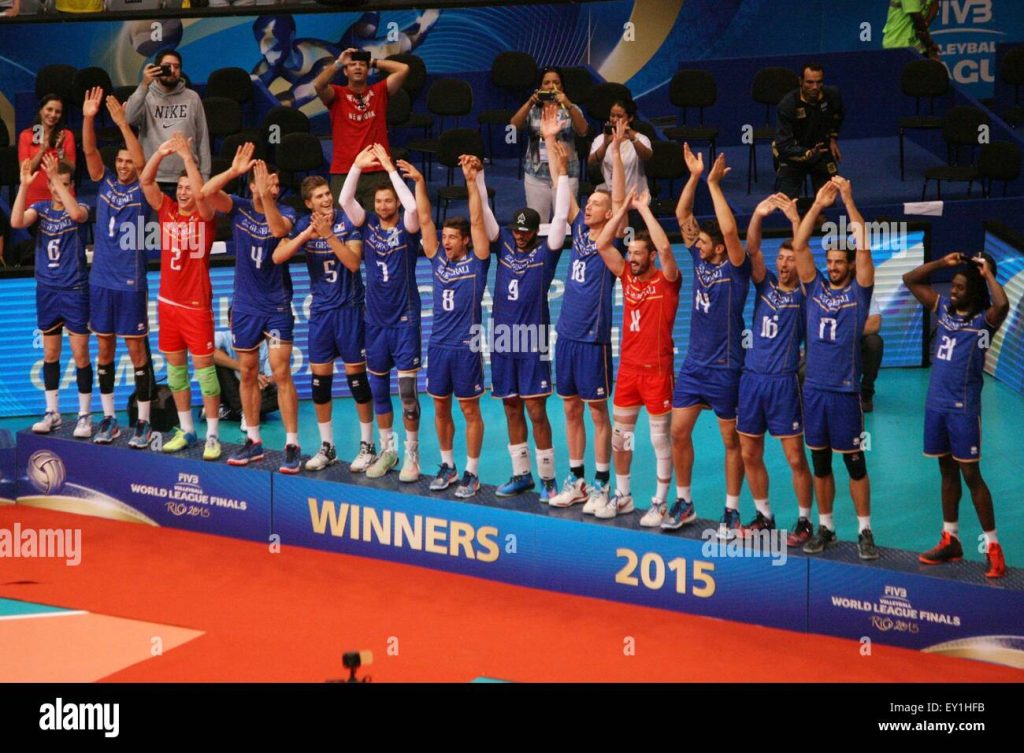
The 2015 Milestone: Record 32 Teams
License: Editorial/Press Use
The 2015 World League represented the tournament’s apex—28 years of development culminating in record participation and global reach.
For the first time, 32 national teams competed across all three groups, representing all five continental confederations. European powerhouses (Italy, Poland, Russia, Serbia, France) competed alongside African nations (Egypt, Tunisia), North American programs (USA, Canada, Mexico, Cuba), South American teams (Brazil, Argentina, Venezuela), and Asian representatives (Japan, China, Australia). The tournament had achieved truly global participation.
The Group 1 finals held special significance: Rio de Janeiro’s Ginásio do Maracanãzinho hosted the championship rounds as an official 2016 Summer Olympics test event. This positioning elevated the tournament’s prestige while providing crucial venue preparation for the following year’s Olympic Games.
France claimed their first World League title with a dominant straight-sets victory over Serbia (25-19, 25-21, 25-23). Earvin N’Gapeth earned MVP honors with exceptional offensive performance throughout the tournament, establishing himself as one of international volleyball’s brightest emerging stars.
The semifinals featured dramatic five-set matches: Serbia defeated USA (25-23, 25-21, 19-27, 20-25, 15-12), and France edged Poland (25-23, 25-23, 19-25, 22-25, 17-15). USA claimed bronze over Poland in straight sets.
Prize money had grown substantially from the 1990 inaugural $1 million—the 2015 Group 1 champion received significant purse alongside comprehensive global television coverage. Media attention peaked alongside participation numbers, demonstrating volleyball’s expanded international footprint.
Why the World League Ended: The 2018 Transition
In October 2017, FIVB announced the most significant format change in 28 years: the Volleyball Nations League would replace the World League starting in 2018. The decision reflected several accumulated challenges that the three-group system had created.
Broadcasting complexity had become a primary concern. Multiple simultaneous finals across three groups fragmented television coverage and diluted audience attention. In the streaming era, viewers preferred concentrated championship spectacles over distributed competition spread across weeks and multiple locations.
The promotion/relegation system between groups created unpredictable yearly lineups that made long-term scheduling difficult for broadcasters and sponsors. Teams entering Group 2 rarely accumulated sufficient experience to advance to Group 1 competition, making the development pathway more theoretical than practical.
Schedule congestion posed logistical challenges. The 28-day tournament span with staggered finals across groups diluted the narrative arc that drives sports broadcasting engagement. Coaching staffs faced extended international duty windows that conflicted with club seasons and Olympic preparation schedules.
The Volleyball Nations League addressed these concerns through structural and commercial simplification. The home-and-away World League format was expensive to produce—teams constantly traveling between continents for individual matches created significant logistical costs. The VNL introduced a “pool weekend” system where four teams meet in a single host city for a weekend of matches, dramatically reducing travel expenses while maintaining competitive quality.
The inaugural 2018 edition featured a single 16-team pool playing 12 matches each over three weeks, followed by a concentrated finals week. This format provided cleaner broadcast windows, predictable scheduling, and easier international marketing.
The VNL also introduced a controversial “core team” system—12 nations with guaranteed participation regardless of results, plus 4 challenger teams rotating based on performance. This marked a philosophical shift from the World League’s pure merit-based promotion/relegation system. Volleyball purists debate whether competitive integrity was sacrificed for commercial stability, but the format has persisted and expanded to 18 teams as of 2025.
All-Time Records and Legacy
The FIVB Volleyball World League’s 28-year history established records and legacies that continue to shape international volleyball.
Brazil’s 9 championships stand as the all-time record. Their eight consecutive finals appearances from 2001-2008 demonstrated sustained excellence unmatched in tournament history. Combined with 8 silver medals and 6 bronze medals, Brazil accumulated 23 total World League medals—a comprehensive dominance that spanned multiple eras.
Italy’s 8 championships make them the second-most successful World League nation. Their 1990s dynasty (8 titles in 11 years) established European volleyball’s global competitiveness and created the systematic development model that other nations eventually replicated.
The MVP award provides individual perspective on tournament history. Brazilian players claimed the honor most frequently, with setters and outside hitters dominating the recognition. Italy’s Lorenzo Bernardi (1992, 1996) and Serbia’s Ivan Miljković (2001, 2002, 2003, 2005) earned multiple MVP awards across consecutive seasons.
Only Brazil and Italy participated in every single World League edition from 1990 through 2017—a distinction that reflects both competitive consistency and organizational stability. Russia, Cuba, and the various Yugoslav successor states (Yugoslavia, Serbia & Montenegro, Serbia) maintained nearly continuous participation throughout the tournament’s history.
The World League’s developmental impact extended beyond championships. The three-group system provided competitive platforms for nations that lacked the infrastructure to host home-and-away elite matches. Players from emerging volleyball nations gained international experience that elevated their domestic programs.
Television broadcasting agreements established during the World League era created frameworks that continue to govern international volleyball coverage. The tournament proved that annual volleyball competition could attract significant audiences and sponsor investment, validating the model that the Volleyball Nations League continues today.
Frequently Asked Questions
Brazil won 9 FIVB Volleyball World League titles, making them the most successful nation in tournament history. Their championships came in 1993, 2001, 2003, 2004, 2005, 2006, 2007, 2009, and 2010. Brazil dominated the 2000s particularly, winning 8 of 10 titles during that decade.
The FIVB Volleyball Nations League (VNL) replaced the World League starting in 2018.
The VNL features a simplified 16-team (expanded to 18 teams from 2025) single-pool format with a concentrated finals week, addressing the broadcasting and scheduling challenges that the World League’s three-group system had created.
Serbia’s Ivan Miljković holds the all-time record with four MVP awards (2001, 2002, 2003, 2005)—the only player to win four times. Italy’s Lorenzo Bernardi earned two MVP honors (1992, 1996), as did France’s Earvin N’Gapeth (2015, 2017) in the tournament’s final editions.
Why did Italy dominate the 1990s World League?
Italy’s 1990s dominance (8 of 11 titles) resulted from several converging factors: Serie A provided the world’s most competitive domestic league, systematic coaching development created tactical advantages, and European geography facilitated frequent international competition. Players like Andrea Zorzi, Lorenzo Bernardi, and Andrea Giani combined individual excellence with team discipline.
What was the format of the Volleyball World League?
The World League evolved from a simple 8-team round-robin (1990) to a complex three-group system (2006-2017). Group 1 featured 8 elite teams in home-and-away competition plus finals. Groups 2 and 3 provided competitive and developmental platforms for additional nations. The tournament typically ran May through July annually.
Did the USA ever win the World League?
Yes, the USA won one World League title in 2014, defeating Brazil 3-1 in the final. Taylor Sander earned MVP honors for that tournament. The USA also won in 2008, with Lloy Ball as MVP—breaking Brazil’s six-year championship streak and gaining momentum heading into the Beijing Olympics.
When was the last World League held?
The 2017 edition was the final FIVB Volleyball World League. France won the championship, defeating Brazil 3-2 in a five-set final held in Curitiba, Brazil. Earvin N’Gapeth earned his second MVP award. The tournament was replaced by the Volleyball Nations League beginning in 2018.
Conclusion
The FIVB Volleyball World League’s 28-year run transformed international volleyball from a quadrennial spectacle into an annual tradition. From Italy’s systematic dominance in the 1990s through Brazil’s unprecedented 2000s success to the competitive parity that emerged in the final years, the tournament chronicled the sport’s global development in real-time.
Understanding this history enriches appreciation for modern international volleyball. When you watch the Volleyball Nations League today, you’re seeing the direct descendant of the World League—same home-and-away structure, same finals-round drama, same nations battling for supremacy. The players have changed, but the competitive DNA traces directly back to that 1990 inaugural tournament in Tokyo.
For those of us who grew up watching World League matches and dreaming of competing at that level, the tournament represented what volleyball could become. The tactical sophistication, the athletic excellence, the national pride on display every summer—it set the standard that continues to define elite international competition.
The next time you see Brazil face Italy or watch France challenge Poland, remember that these rivalries were forged across 28 years of World League competition. The history matters.