I still remember the exact moment during our Intercollegiate Tournament finals when scoring knowledge became the difference between panic and clarity. We’d pushed the match to Set 5, and as we crossed to the other side of the net at the 8-point changeover, half our bench looked confused. Eight points? Nobody warned them about that. Our setter called a quick huddle at the water break and you could see it on their faces — they’d been thinking about this like a regular set, not a 15-point sprint where every single point was worth twice as much.
We won that set 15-13. But the point isn’t the outcome. The point is that we played the first eight points like we had margin to spare, because nobody had fully internalized how the structure of Set 5 changes your decision-making. Knowing the full rules of volleyball is one thing. Understanding how scoring mechanics actually shape what happens on the court is another.
This guide covers both. Take your time to bookmark this post till you commit these to your memory.

Quick Reference: Volleyball Scoring at a Glance
| Format | Sets Played | Points to Win Set | 5th Set | Win by |
|---|---|---|---|---|
| Best-of-5 (standard) | Up to 5 | 25 | 15 (change sides at 8) | 2 points always |
| Best-of-3 (youth/rec) | Up to 3 | 25 | 15 | 2 points always |
| Beach volleyball | Up to 3 | 21 | 15 | 2 points always |
| No point cap | All levels | Unlimited | Unlimited | 2-point lead required |
Rally Scoring: The Rule That Removed the Safety Net
Before 1999, volleyball used side-out scoring — a system where only the serving team could earn a point. If the receiving team won the rally, they got the serve but nothing went on the scoreboard. Sets were played to 15, matches dragged, and television networks hated the unpredictability.
The side-out system had one quiet effect that most people forget: it gave players a mental safety net. You could take a risk on serve receive, gift the opponent a great first ball, and lose the rally — and nothing changed except you got the serve back. No harm done to your score.
Rally scoring ended that. FIVB adopted it internationally in 1999, and the entire psychological weight of the game shifted overnight. Now, every single rally ends with a point on the scoreboard — for one team or the other, regardless of who served. When you miss a serve today, you don’t just lose possession. You hand the opponent a free point and the serve. Now, the pressure is constant from first whistle to last.
Here’s the practical reality: in a 25-point set, if both teams are playing at high efficiency, you’re looking at 40–50 rallies. Every one of those rallies matters. There’s no throwaway moment. That’s what makes volleyball under rally scoring one of the most mentally demanding sports at the competitive level.
The core rule, stated plainly: One point is awarded after every rally, to the team that wins it, regardless of who served. A team wins a set by reaching 25 points with at least a two-point lead. The fifth set is played to 15 points with the same two-point requirement. There is no point cap in FIVB, NCAA, or USAV competition — play continues until the two-point margin is achieved.
Set Structure: What You’re Actually Playing For
A standard volleyball match is best-of-five sets. The first team to win three sets wins the match. Each of the first four sets is played to 25 points, win by 2. If the match reaches a fifth set, the format changes.

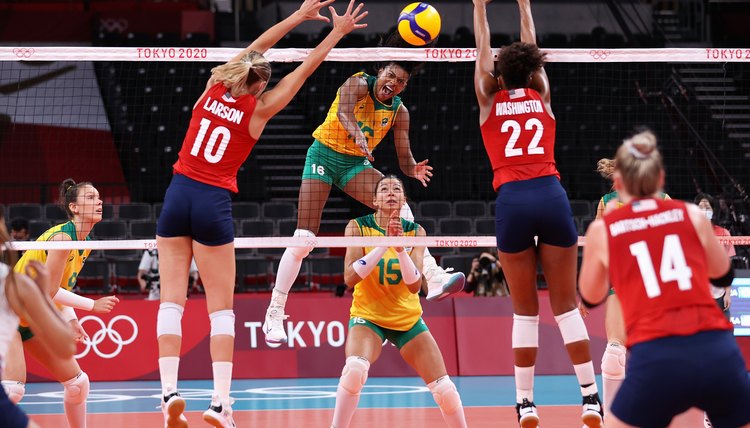
Set 5 is played to 15 points, win by 2. It also has one structural detail that surprises a lot of people watching for the first time: teams change ends at 8 points, mid-set, with no break in play. It’s not a halftime. The referee signals the changeover, teams switch sides immediately, and the rally resumes. This exists to neutralize any court-side advantage — lighting, wind in an outdoor setting, crowd position — that might affect one team across a full set.
From a coaching perspective, that changeover is a moment. Coaches will sometimes call their timeout in the rallies just before 8 specifically to disrupt the opponent’s rhythm during the transition, or to reset their own team’s focus before the second half of the sprint. It’s a small tactical window that experienced coaches know to use.
In a best-of-three format — common in youth leagues, recreational play, and some high school formats — the structure is the same for the first two sets (to 25), with a third set tiebreaker played to 15.
One thing worth clarifying: the concept of a “cap” — a point limit that ends a set regardless of the two-point lead — does exist in some recreational and lower-level formats to keep matches within time constraints. But in competitive volleyball at any serious level (FIVB, NCAA, USAV), there is no cap. A set at 29-29 continues until someone leads by two. I’ve personally watched a fourth set go to 35-33 in a regional tournament. The two-point rule is absolute.
How Points Are Scored: The Obvious and the Invisible
Most people understand the basics. Your team grounds the ball in the opponent’s court — point. The opponent sends it out of bounds — point. Three contacts, no return — point. That’s the foundation, and it’s correct.
What trips up players, parents, and new scorekeepers are the “invisible faults” — situations where the whistle blows and the scoreboard changes but nobody saw the ball hit the floor. These calls drive confusion in the stands and arguments in the team huddle. Here’s what’s actually happening.
The Obvious Ways to Score
Your team earns a point when the ball lands inside the opponent’s court boundaries, when the opponent contacts the ball four times before returning it, when the opponent’s shot travels out of bounds (including off a block — if the ball exits the court after deflecting off your blockers, that’s your point), or when the opponent commits a service fault.
The Invisible Faults — Why the Whistle Blows Before the Ball Lands
Positional fault (overlap):
At the exact moment the server contacts the ball, every player on both teams must be in their correct rotational position. If two players are overlapping — a front-row player too close to the back row, or a right-side player too far to the left — the first referee calls a positional fault. That’s a point and the serve for the opponent. No ball needs to land. The fault happens at the serve.
This is the call that generates the most post-game questions. A team will run a perfectly clean rally, win it, and then have it reversed because someone was half a foot out of position at the serve. The rotation structure that governs this is enforced on every single rally, every single set. If you’re running a 5-1 system, understanding how each rotation affects your overlap exposure directly changes how you manage positional discipline during the serve.
Net fault:
A player touches the net between the antennae during their action of playing the ball. Worth being precise here, because not every net touch is a fault. Incidental contact with the net outside the antennae, or contact caused by the ball hitting the net and pushing it into a player, is not automatically called. The fault is specifically contact during the action of playing the ball. Touch the net reaching for a block? Fault. Brush the net post while walking to position after the rally? Not called.
Four-contact fault:
A team touches the ball four times before returning it. Blocks don’t count as a contact — a blocked ball can be played again by the same team. But if the sequence is: block, pass, set, attack, and then a player tips it again trying to keep it alive — that fifth touch from the blocking team’s perspective (which is really a four-contact violation) ends the rally.
Screening:
When the serving team intentionally hides the server or the flight of the ball from the receiving team — typically by waving arms, jumping, or forming a human wall in front of the server — the referee calls a screening fault. Point to the receiving team. This one’s rare at the recreational level but comes up regularly in competitive play, particularly with jump serves from the back line.
Back-row attack violation:
A back-row player (positions 1, 6, or 5) cannot complete an attack hit from in front of the attack line if the ball is entirely above the height of the net at contact. The attack line is 3 meters from the net on each side. A back-row player who jumps and attacks from behind the line, landing in front of it, is fine — it’s about where contact happens, not where they land.
Libero attack fault:
The libero cannot complete an attack hit above net height from anywhere on the court. They also cannot serve, block, or attempt to block. When a libero gets a high ball near the net and tries to attack it, the first referee calls the violation immediately.
I played in a regional tournament where we lost a set-deciding point to a positional fault that nobody on either bench understood in the moment. The referee called it, pointed to the other team, and the match was over. Half the gym was still trying to figure out what happened. These aren’t obscure rules — they’re in every single match. Knowing them means you never get blindsided.

Sanctions: When Conduct Puts Points on the Board
This section exists because broadcasts increasingly show yellow and red cards, and most viewers have no idea what they mean for the score.
Volleyball has a four-level sanction system under FIVB Rule 21. Here’s what each level does to the scoreboard:
Warning (yellow card): Shown to the team captain or coach. No point awarded. Consider it the first official notice — the referee is documenting the behavior. Each team gets one warning per set before escalation.
Penalty (red card): This is where the scoreboard changes. A red card awards one point AND the serve to the opposing team. Immediately. It doesn’t matter what the current rally situation is — the opposing team receives a free point and steps to the service line. I’ve watched a set end 25-24 on a red card for time-wasting. The server was deliberately slow approaching the line after the second referee had already issued a yellow card in the same set. The point went on the board before anyone served.
Expulsion (red + yellow card simultaneously): The sanctioned player or coach must leave the playing area for the remainder of the set. The opposing team receives a point and the serve, same as a red card.
Disqualification (red + yellow card on separate hands): The individual is removed for the match. Again, one point and the serve to the opponent.
Points awarded through conduct sanctions count identically to any other point. They appear on the scoreboard the same way, they count toward the set total the same way, and they can be — and regularly are — the margin in a tight set.

Set 5: The Pressure Cooker
A lot of coaches treat Set 5 like a shorter version of Sets 1–4. That’s a mistake. The format is different enough that it rewards a different mental approach.
In Sets 1–4, each point represents roughly 4% of what you need to win the set. You have room to absorb a 4-0 run, call a timeout, reset, and come back. At 10-15, you’re behind but not out. The math still gives you a reasonable path.
In Set 5, each point is roughly 6.7% of the required total. A 4-0 run doesn’t put you in a hole — it puts you in a crater. A team that goes down 6-1 in Set 5 is in genuinely difficult territory. Not impossible, but the math is compressed.
The changeover at 8 points adds a layer. The leading team at that moment crosses to the opposite side still carrying their momentum. Smart coaches use the brief transition to re-anchor their team — not to change tactics, but to reset the emotional register. “We’ve won 8, not 15. Nothing’s over.”
Serving becomes more consequential in Set 5 because service errors — which gift the opponent a free point — represent a larger percentage of the set total. A team that can control their serve and apply pressure with it, rather than going for aces at the cost of errors, tends to close out Set 5 more consistently than the team playing hero ball from the service line.
Pro Volleyball in 2026: What LOVB and MLV Mean for Scoring
If you’re watching volleyball in the US right now, you’re likely following one or both of the professional leagues that have emerged over the last two years.
LOVB Pro launched its inaugural season in January 2025 and LOVB Austin won the first championship, sweeping LOVB Omaha 3-0 in the finals at Louisville. The 2026 season is currently underway with the same six franchises. LOVB uses win percentage for standings — all match wins count equally regardless of whether the win was 3-0 or 3-2. There are no “bonus points” for sweeps in LOVB.
Major League Volleyball — rebranded from the Pro Volleyball Federation — enters its 2026 season with eight franchises after significant off-season restructuring. The Orlando Valkyries are the 2025 champions. MLV similarly ranks teams by win-loss record, with set ratio and points ratio serving as tiebreakers.
This is worth flagging because some international leagues — including India’s Prime Volleyball League and certain European club competitions — use a tiered points system where a 3-0 win earns more standing points than a 3-2 win. Under those systems, every set genuinely matters for the table, not just match outcome. US pro volleyball doesn’t work that way at present. In LOVB and MLV, the scoreline of a win doesn’t affect your standing position — but it does matter if tiebreakers are needed at season’s end.
For fans new to the sport, this is relevant context: when you see a team “settle” for a 3-2 win rather than pushing aggressively to close in four, it’s not necessarily poor strategy. They’ve secured the same standing points either way.
Scoreboard IQ: Reading the Board in Five Seconds
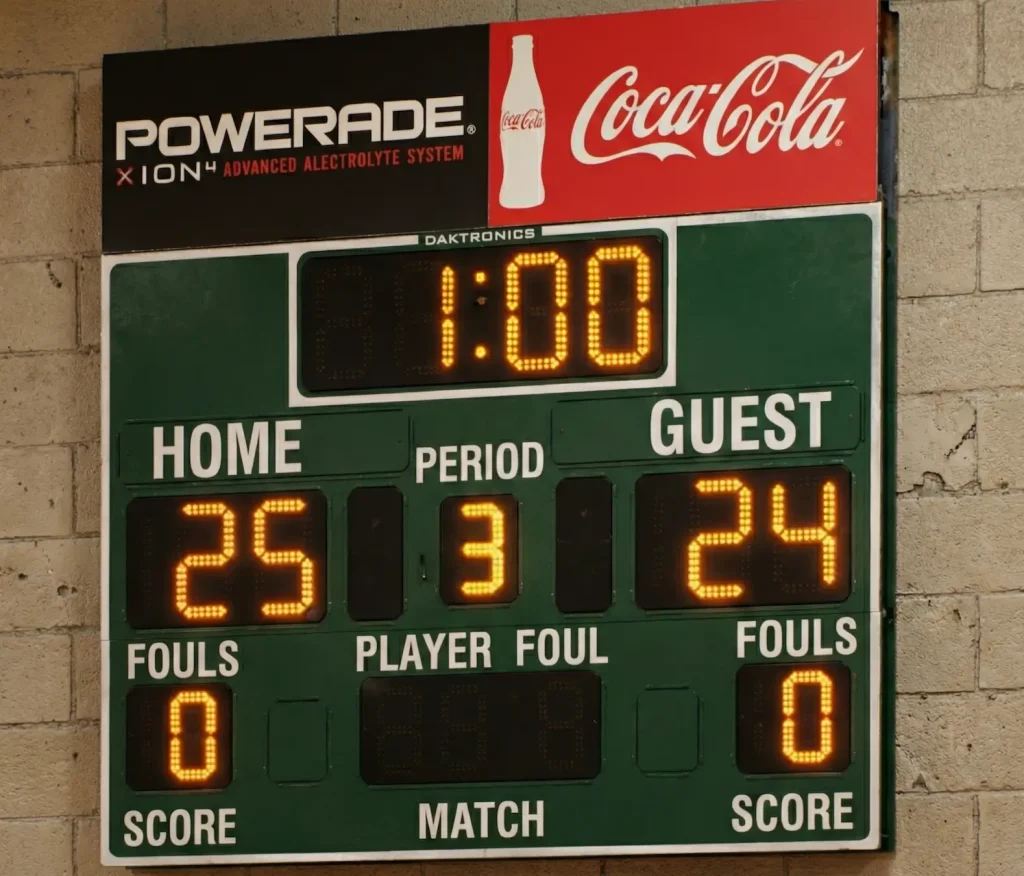
Whether you’re a scorekeeper, a parent in the bleachers, or a player glancing at the board during a timeout, the scoreboard tells you everything you need in a single look once you know the language.
| Display Element | What It Shows |
|---|---|
| Large numbers | Current set score (this set only) |
| Small numbers (top or sides) | Sets won by each team |
| Arrow or indicator light | Team currently serving |
| T or boxes | Timeouts remaining this set |
The left number is always the home team; the right is the visiting team. This is universal — it holds in high school gyms, college arenas, and the main courts at LOVB and MLV venues.
The serving indicator matters more than people realize. At 22-20, knowing who’s serving tells you a lot about momentum. If the trailing team has the serve, they control the next rally. If the leading team is serving, they’re in a position to close the set directly with a service winner or a forced error.
For scorekeepers specifically (addressing the question that came in from a reader last season): in rally scoring, every rally results in a point for exactly one team. When the home team serves and the visiting team wins the rally, you mark nothing on the home side — their score stays the same — and you mark one point on the visiting side and record that they now have the serve. The server arrow flips. The serve transferred because the visiting team won the rally, and because they won the rally, they also earned the point. Those two things — serve and point — always go to the same team after every rally.
Technical Violations Quick Reference
Here’s a consolidated reference for the calls that move the scoreboard without a ball landing:
| Violation | What Happens | Point To |
|---|---|---|
| Positional fault (overlap) | Players out of rotation at the serve | Opponent |
| Net fault (during play action) | Player touches net between antennae | Opponent |
| Four contacts | Team touches ball four times before returning | Opponent |
| Back-row attack violation | Back-row player attacks above net height in front of attack line | Opponent |
| Libero attack fault | Libero attacks ball above net height anywhere | Opponent |
| Screening | Serving team intentionally hides serve or server | Receiving team |
| Red card / conduct penalty | Misconduct after prior warning | Opponent gets 1 point + serve |
| Service fault | Ball lands out, goes into net, or foot fault at service | Receiving team |
FAQs
An ace in volleyball is when the serve lands in the opponent’s court without being returned, or is contacted but can’t be kept in play — earning the serving team a direct point. It’s one of the highest-efficiency plays in the game because it ends the rally before it starts.
Yes, a team can lose a point if they commit some fault. This can include serving the ball into the net or hitting the ball out of the boundary.
A set is a part of the match. The teams compete to reach 25 points first, with at least a lead of two points.
Also called a match, a game consists of multiple sets.
In a best-of-five format, the first team to win three sets wins the match.
What is the match point in Volleyball?
Match point refers to the situation where one team is just one point away from winning the match.
To win the match, the team must achieve the required number of set victories, and during match point, they only need one more successful play to secure the final set and the overall match.
What happens if the score reaches 24-24 in a set?
Play continues until one team achieves a two-point lead. There is no cap in competitive volleyball. The set could end 26-24, 30-28, or higher — the margin must be two.
Can a libero serve?
Under standard FIVB and NCAA rules, the libero cannot serve. In some USAV recreational formats, a modified libero rule allows serving in one rotation position — but this is a format-specific exception, not the standard rule.
How many sets do you need to win a volleyball match?
In the standard best-of-five format, you need to win three sets. In best-of-three formats, you need to win two. The final set in either format is played to 15 points.
Is there a cap on points in volleyball? In competitive volleyball under FIVB, NCAA, or USAV rules — no. You play until the two-point margin is achieved, regardless of how high the score climbs. Some recreational formats use a cap (often 27 or 30 in sets 1-4) to manage time. If you’re in an organized competitive league or tournament, assume there is no cap unless explicitly told otherwise.
What’s the difference between a set and a match? A set is a single scoring unit played to 25 (or 15 in the fifth set). A match is the full competition — the series of sets. You win a set by points, and you win a match by winning the required number of sets.
Hey,
How many hits per side are there in Volleyball?
Hello Brin,
Each team gets three touches/hits to return the ball over the net:
Pass/Bump – First contact to control the ball
Set – Second contact to position the ball for attack
Attack/Spike – Final contact to send ball over the net
Important: Blocks don’t count as one of the three hits. If a team doesn’t get the ball over within three hits, the other team scores a point.
Hello. This is my 2nd year doing volleyball books. I’m not sure if they told me or not. And I can’t seem to find the correct answer online. If the home team serves, but the opposing team gets the point. What do I put on the scorebook (the book were we keep the points and everything) for the home.
Hey Erica! Great question about scorekeeping – it’s one of those details that can trip up even experienced scorekeepers.
When the home team serves but the visiting team wins the rally and gets the point, here’s what you do in the scorebook:
For the home team’s side of the scorebook: You don’t mark anything new. The home team doesn’t get a point, so their score stays the same as it was before that rally.
Visiting Team Scorebook:
The visiting team gets the point AND gains the right to serve next.
So you’d mark the point on the visiting team’s side of the scorebook and indicate that they now have the serve.
So, the main thing is: In Rally scoring system, only the team that wins each rally gets a point – it doesn’t matter who was serving. The serve just determines which team starts that particular rally.
So if the score was Home: 15, Visitors: 12 before the rally, and the home team served but the visitors won the point, the new score would be Home: 15, Visitors: 13, with the visitors now having the serve.
So in rally scoring, every single rally results in a point for somebody, regardless of who served.
Hope this clears things up! Scorekeeping gets easier once you get the hang of the rally system. You’re doing great by asking questions in your second year – that attention to detail will make you a solid scorekeeper.